How to Spot a Fake ID: A Practical Verification Guide
Fake IDs now land in onboarding queues, not just at the bar. A repeatable, six-step way to check identity documents — starting with the barcode most forgers forget.
In this guide
- Key takeaways
- Step 1: Start with the barcode, not the face
- Step 2: Read the fonts like a stranger
- Step 3: Check the number formats against the issuer
- Step 4: Weigh the physical security features you can actually see
- Step 5: Cross-check the person against the document
- Step 6: Score it, don't vibe it
- A quick illustration of where fakes fall apart
- Frequently asked questions
Fake IDs used to be a bouncer's problem. Now they land in onboarding queues, rental applications, marketplace signups, and any workflow where "upload a photo of your ID" is the last gate before money moves. The counterfeits got good — good enough that a quick eyeball at a thumbnail catches almost none of them. If your job is to say yes or no to a stranger's identity document, this is the guide I wish more teams read before they got burned.
The goal here isn't to turn you into a forensic examiner. It's to give you a repeatable order of operations, so the same document gets the same scrutiny whether it's the first one you've seen today or the four-hundredth.
Key takeaways
- Most fake IDs fail on consistency, not on any single dramatic flaw — the name, the barcode, and the printed fonts disagree with each other.
- The PDF417 barcode on the back is the single highest-value check, and it's the one fraudsters most often forget to make match the front.
- Photos of IDs (not physical cards) hide most physical security features, so you lean harder on data cross-checks and image forensics.
- A verdict is only as good as the worst check you skipped. Build the order once and run all of it, every time.
Step 1: Start with the barcode, not the face
Almost everyone starts by looking at the photo and the name. Fraudsters count on that. The back of a U.S. or Canadian ID carries a PDF417 barcode, and it encodes the same fields printed on the front — name, date of birth, address, document number, expiry, issue date. It follows a public standard (AAMVA), so it's trivial to decode.
Here's the thing: forgers spend their effort making the front look pretty. The barcode is an afterthought. So the fastest tell in the whole document is a barcode whose decoded data doesn't match the printed front. Different middle initial. Birth date off by a year. A document number that doesn't follow the issuing state's format. When the two sides disagree, you're done — you don't need any other check.
If the barcode is missing, unreadable, or decodes to garbage on a card that should have a clean one, treat that as a flag on its own. Real IDs are manufactured; their barcodes scan.
Step 2: Read the fonts like a stranger
Every issuing authority prints with a specific, boring consistency. The same typeface, the same weight, the same baseline, field after field. Humans forging a card almost never match it perfectly, because they're overlaying new text onto a template and the kerning drifts.
Look for:
- A name or date of birth in a subtly different font than the labels around it.
- Characters that don't sit on the same baseline — one digit floating a hair high.
- Uneven spacing between letters in one field while every other field is even.
- A ghost of the original text under a patched-in value, especially on a re-used template.
This is where a photo of a card can actually help you: zoom in. Screen captures and phone photos preserve the pixel-level artifacts of a bad paste job better than a glance at a physical card under bad lighting ever could. The same techniques that flag a Photoshopped image apply here — you're hunting for the seam where two things were joined.
Step 3: Check the number formats against the issuer
Every field has rules. Document numbers follow per-state patterns. Dates have to be internally coherent — issue date before expiry, birth date consistent with the person's claimed age, expiry that matches the issuing period that state actually uses. A 25-year-old holding a card that "expires" on a schedule that state stopped using years ago is holding a template someone downloaded.
You don't have to memorize fifty formats. You have to notice when something looks off and be willing to look up the real pattern. The fakes that survive are the ones nobody bothered to challenge.
Step 4: Weigh the physical security features you can actually see
If you're handling a card in person, this is where holograms, microprinting, tactile printing, and UV features come in. Tilt it. Real optically variable devices shift; a printed picture of a hologram doesn't. Microprint that reads as a clean line to the naked eye should resolve into crisp text under a loupe — forgers reproduce it as a fuzzy smear.
But be honest about your channel. If all you ever receive is a photo of an ID uploaded through a form, most of these features are gone. A hologram photographs as a glare blob. You can't feel tactile printing through a JPEG. Don't pretend a data check is a security-feature check — know which one you're actually doing, and lean on Steps 1–3 harder when the physical layer is unavailable.
Step 5: Cross-check the person against the document
The document can be genuine and still be wrong for this transaction. A real ID that belongs to someone else is the oldest trick there is. Does the name match the application? Does the face match a selfie, if you collect one? Does the address align with the rest of the file, or does this one document disagree with everything else the applicant submitted?
This is also where synthetic identities hide: a document that's internally consistent and passes every format check, because it was built carefully around a fabricated person who has no real history behind the name.
Step 6: Score it, don't vibe it
The failure mode I see most often isn't a missed hologram. It's inconsistency in the reviewer. The same document gets waved through on a busy Monday and rejected on a slow Friday, because the decision lived in someone's gut.
Turn your checks into a score. Front/back match: pass or fail. Font consistency: pass, minor, fail. Number formats valid: yes or no. Physical features (if available): present, absent, N/A. Person-to-document match: yes or no. Now your "no" has a reason attached, your team is consistent across reviewers, and your audit trail explains itself six months later when someone asks why you approved account 41,902.
This is exactly the kind of judgment that scales badly by hand and well with tooling. A forensic document check runs the barcode decode, the font and layout analysis, and the tamper detection in one pass and hands back a verdict with the evidence attached — so the human is reviewing a flagged case, not squinting at every upload.
A quick illustration of where fakes fall apart
Across the ID reviews we help teams triage, the single points of failure cluster in a predictable way. This is illustrative, not a study — but the shape holds up in the field:
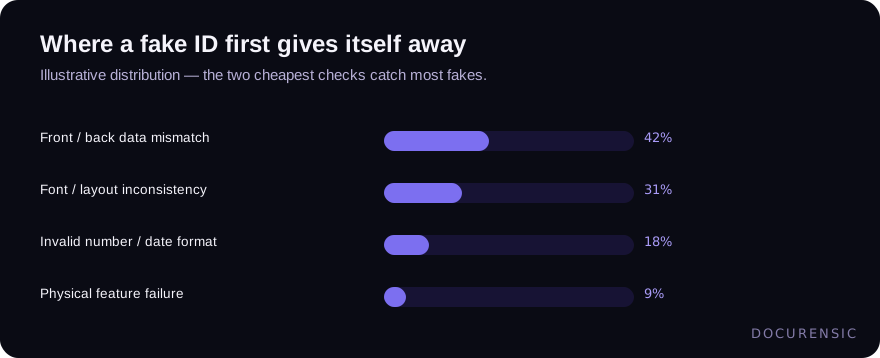
The lesson buried in that chart: the two cheapest checks — comparing the barcode to the front, and reading the fonts — catch roughly three out of four fakes before you ever get to the hard forensic work. Start there.
Frequently asked questions
Can you spot a fake ID from a photo instead of the physical card?
Often, yes — but you're checking different things. A photo hides holograms and tactile printing, so you rely on data consistency (front vs. barcode), font and layout analysis, and image tamper detection. Many counterfeits fail those checks regardless of the physical card quality, because the forger edited a template rather than manufacturing a card.
What's the fastest single check for a fake ID?
Decode the PDF417 barcode on the back and compare it to the printed front. Forgers polish the front and neglect the barcode, so a mismatch is both common and conclusive. It takes seconds and needs no special equipment beyond a scanner or a decoder.
Are AI-generated fake IDs harder to detect?
They raise the floor on visual quality, but they don't fix the structural problem: the document still has to be internally consistent and match a real person's history. Generated IDs frequently nail the look and fail the cross-checks — barcode data that doesn't align, number formats that don't match the issuer, or a person with no verifiable footprint behind the name.
Do I need special hardware to verify IDs at scale?
No. High-volume verification is mostly data and image analysis, which is software. Hardware (UV lights, loupes, magnetic readers) matters when you physically hold cards, but most modern onboarding flows receive uploaded images — so scale comes from automating the barcode, font, and tamper checks and routing only the flagged cases to a human.
Put it to the test
Scan a document and get a plain-English verdict in seconds. Free to start.
Keep reading
Reading the MRZ: How to Verify a Passport Like a Border Officer
Those two lines of angle brackets at the bottom of a passport are a built-in verification system. How the MRZ works, how to check its math, and where fakes get it wrong.

Gig Onboarding Fraud: Fake Drivers, Rented Accounts, Borrowed Faces
Gig platforms onboard workers with document checks — and fraudsters attack exactly there. Fake licenses, rented accounts, and synthetic profiles, plus the checks that hold.
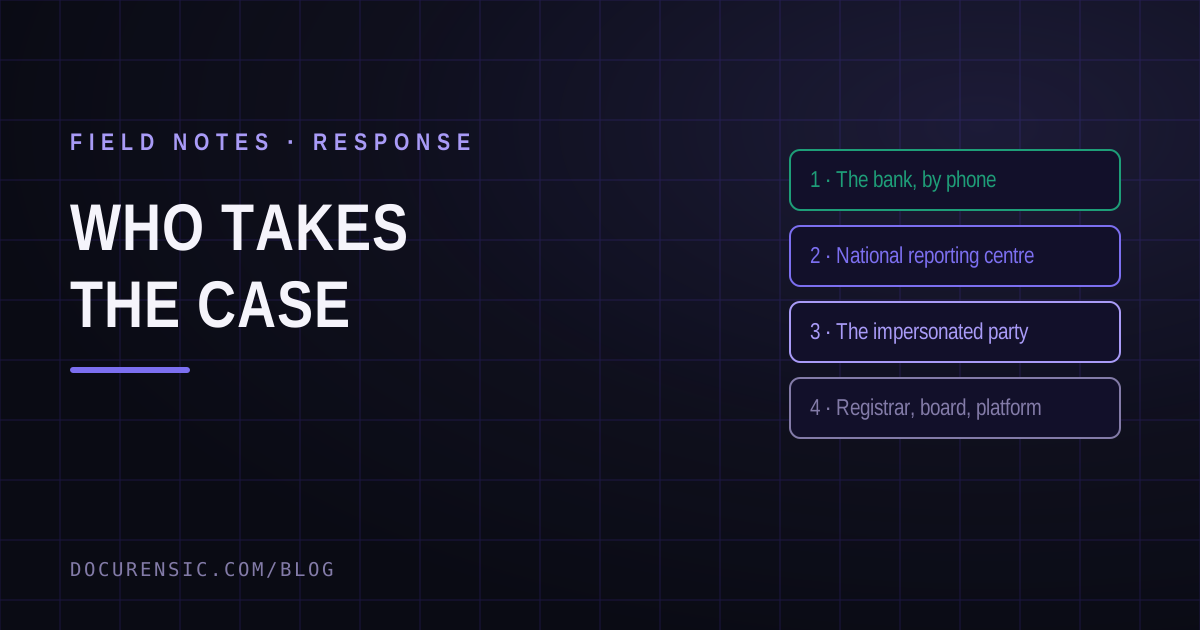
Where to Report Document Fraud: Who Takes the Case
The bank first, within hours, because that is the only step that recovers money. Then the national centres in the US, UK, Canada and Australia — and the four reports almost nobody files that change outcomes most.