How to Verify a Degree: Beating Diploma Mills in Hiring
Fake credentials come in two flavors: forged diplomas from real schools, and real diplomas from fake schools. How to verify a degree and catch the diploma mill.
Somewhere between the résumé and the offer letter, a claimed degree usually gets a nod and no more. The candidate says they have a BSc from a university you've heard of, it's on the CV, everyone moves on. That gap — between claiming a credential and confirming it — is where a whole industry of fake degrees lives, and it's wider than most hiring teams admit.
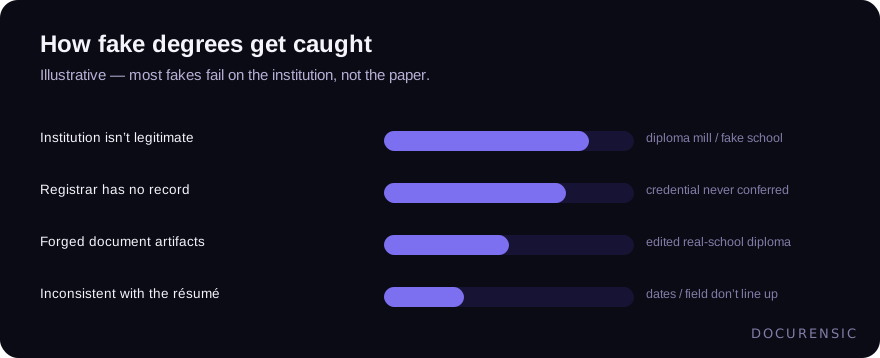
Fake credentials come in two flavors, and telling them apart is the key to checking efficiently. There's the forged document (a real university's diploma, faked) and the diploma mill (a fake university that issues "real" documents for its worthless degrees). Different problems, different checks.
Key takeaways
- A diploma document is easy to fake and easy to buy — the paper is never the proof.
- The real question is whether the institution is legitimate and whether it actually conferred the credential.
- Diploma mills are the trickier threat: the document is genuinely issued, but by a fake or unaccredited "university."
- Verify with the institution or a verification service for anything that matters; use document checks to triage.
The two problems, kept separate
Forged diplomas take a real, accredited university and fake its diploma or transcript — the candidate never attended, or attended and inflated the degree. Here the institution is real and the document is the lie, so you catch it the way you catch any forgery: the document won't survive contact with the institution's own records, and it often carries editing tells.
Diploma mills are the inverse and the nastier of the two. The "university" is fake — an official-sounding name, a slick website, maybe a real-looking accreditation logo — and it genuinely issues diplomas and transcripts for its degrees. The document is authentic; the credential behind it is worthless. You can't catch this by examining the paper, because the paper is real. You catch it by examining the institution.
Step 1: Verify the institution before the document
Flip the usual order. Before you scrutinize the diploma, ask whether the school issuing it is a real, accredited institution. Is it recognized by a legitimate accrediting body — not a made-up "accreditation council" the mill created to accredit itself? Does it have a real academic footprint, or just a domain and a payment page? A degree from an institution that isn't real fails regardless of how genuine the certificate looks. This is a verify-the-organization problem before it's a document problem.
Watch for the mill tells: a name confusingly similar to a famous university, "accreditation" from a body no one recognizes, degrees offered "based on life experience," and a turnaround measured in days.
Step 2: Confirm the credential with the source
For a real institution, the document is not the proof — the registrar's record is. Verify the degree directly with the institution, or through a legitimate credential-verification service or clearinghouse where available. This confirms the person actually earned the credential they're claiming, in the field and at the level stated. It's the step that turns "they have a diploma" into "they earned this degree," and it's the only one that fully closes the loop.
Step 3: Use document analysis to triage
You won't send every credential to full verification — so use the document to decide which ones need it. A forged diploma or transcript often carries the usual tamper artifacts: a name or degree in a mismatched font, a grade or date typed over a template, a seal or signature that's a low-resolution paste, metadata showing the "scan" was authored in editing software. These don't prove the credential is real, but they reliably flag the ones worth a hard look.
Step 4: Cross-check against the rest of the application
Fabricated credentials often don't fit the rest of the story. A degree whose dates overlap impossibly with claimed employment, a field of study that doesn't match the career, an institution the candidate can't say much about — these are the seams. The same discipline that catches fabricated employment history applies: make the documents and claims agree, and investigate where they don't.
When to escalate
Match the effort to the stakes. For roles where the credential is load-bearing — licensed professions, senior technical hires, anything with regulatory or safety weight — verify directly with the institution, every time. For lower-stakes roles, document triage plus an institution-legitimacy check may be proportionate. The mistake is treating a diploma image as sufficient proof for a decision that actually depends on the credential being real.
Frequently asked questions
How do I verify someone's college degree?
Confirm two things: that the institution is real and accredited, and that it actually conferred the claimed degree. Check accreditation against a legitimate recognizing body, then verify the credential itself with the institution's registrar or a credential-verification service. The diploma document is only a starting point, not the proof.
What is a diploma mill and how do I spot one?
A diploma mill is a fake or unaccredited "university" that sells worthless degrees with genuine-looking documents. Spot it by the institution, not the paper: a name mimicking a real university, self-created or unrecognized "accreditation," degrees granted for "life experience," and near-instant turnaround. Because the document is really issued, only checking the institution catches it.
Can document analysis alone prove a degree is real?
No — it can flag forged documents, but it can't confirm a credential was earned, and it won't catch a diploma-mill degree whose document is genuinely (if worthlessly) issued. Use document analysis to triage which credentials need it, then confirm the important ones directly with the institution or a verification service.
Put it to the test
Scan a document and get a plain-English verdict in seconds. Free to start.
Keep reading
The Fake Employment Letter: Anatomy of a 20-Minute Forgery
An employment verification letter is a salary claim on a letterhead. Why this document is the easiest fake in the file, and the source-check that defeats every version of it.
Fake Proof-of-Funds Letters: Money That Exists Only on Paper
POF letters grease real estate deals, trade transactions, and investment schemes — and they are trivially forged. What a real one proves, what a fake one costs, and how to verify.
Ghost Brokers: The Insurance Agent Who Never Existed
Ghost brokers sell real-looking insurance that is worthless — forged certificates, cancelled policies, stolen details. How the scheme works and how to check a policy actually exists.