Synthetic Identity Fraud: The Scam With No Victim to Call
Synthetic identities are built, not stolen — a fake person nurtured into a creditworthy profile, then busted out across lenders. Why it beats your checks, and what actually stops it.
Most fraud has a victim who notices. Someone's card gets used, they call the bank, the chargeback lands, the case opens. Synthetic identity fraud is different, and that difference is the whole reason it's so hard to stop: there's no angry customer, because the customer was never real. Someone assembled a person out of spare parts — a real-enough identifier here, a fabricated name there, an address that resolves — nurtured that person into a creditworthy profile over months, then walked away with everything they could borrow. No one calls to dispute it, because no one was wronged in the way your fraud tooling expects.
If you approve accounts, extend credit, or onboard businesses, this is the failure mode most likely to be quietly running through your funnel right now while your dashboards stay green.
Key takeaways
- A synthetic identity is built, not stolen — a mix of fabricated and sometimes real fragments stitched into a person who doesn't exist.
- It defeats identity checks because the documents are internally consistent and the "person" behaves normally, sometimes for years.
- The tell is almost never a single bad document. It's the absence of a coherent history behind an identity that looks flawless on paper.
- Document forensics won't catch a synthetic on its own — but it closes the door on the fabricated documents these schemes lean on at account opening and credit-limit increases.
What a synthetic identity actually is
Picture the ingredients, not the crime. A fraudster needs an identity that clears automated checks. Pure invention rarely survives, because a name with zero footprint looks suspicious. So they blend: a genuine-looking identifier that isn't tied to an alert, a name that's plausible but not a real match, a real deliverable address, a phone number that receives texts. None of it points to a specific living person who'd notice the misuse. That's the point.
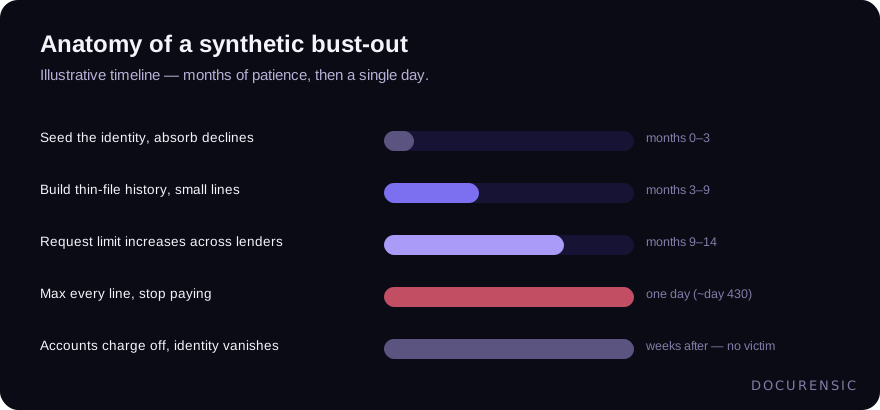
Then comes the patient part. The synthetic applies for credit and gets declined — that's expected, and the decline itself creates a record. It gets added as an authorized user on a cooperating account, or opens a secured line. Little by little, a file forms. Bureaus start to recognize the identity. Six or twelve months later, the "person" looks like a thin-but-real consumer with a modest, improving profile. That's the moment the scheme has been building toward.
The "bust-out" — where the money leaves
The endgame has a name in the industry: the bust-out. The synthetic, now trusted, requests and receives higher limits across several lenders. It uses them normally for a stretch to earn even more rope. Then, over a very short window — sometimes a single day — every line is maxed simultaneously and nothing is ever repaid. By the time the missed payments cascade into collections, there's no one to call. The address goes cold. The phone stops answering. The "identity" simply stops existing, because it never did.
What makes this so corrosive is that each individual lender sees a small loss and a plausible story: a customer who fell on hard times and stopped paying. It's only in aggregate — across lenders who don't share a view — that the pattern is obvious. One person, five institutions, one afternoon.
Why your identity checks pass it
Standard verification asks two questions: does this document look real, and does the data match a record? A well-built synthetic answers both correctly. The documents are internally consistent — the barcode agrees with the front, the fonts are uniform, the math checks out — because the fraudster didn't sloppily edit a stolen ID; they constructed clean artifacts around a coherent fake person. And the data does match a record, because they spent months manufacturing that record.
This is the uncomfortable insight: a synthetic identity doesn't fail the checks designed to catch forged documents or stolen identities, because it is neither. It's a legitimate-looking file wrapped around a hollow core. The document is often genuine in every forensic sense. The person is the forgery.
That's also why "we verify IDs" is not the same as "we can't be hit by synthetics." You can catch every fake driver's license in your funnel and still fund a dozen synthetics a quarter, because the ones that matter didn't bother with a fake license — they brought a clean one that just happens to belong to no one.
What actually moves the needle
Since you can't rely on any single document to unmask a synthetic, you defend in layers — and the layers are about coherence over time, not about one perfect check.
Look for history that's too clean and too shallow. Real people are messy. They have old addresses, dormant accounts, a credit file with texture. A profile that's pristine, thin, and improving in a suspiciously linear way deserves a second look, especially when it starts asking for more.
Watch the velocity. The bust-out is a burst. Coordinated limit-increase requests, sudden utilization spikes across products, several applications from adjacent identities sharing a device, an address, or a phone — those correlations are where synthetics show up, because one operator runs many of them.
Cross-check the artifacts you do receive. At account opening, at credit-limit increases, at any step where the "person" hands you a pay stub, a bank statement, or a utility bill, that document is a pressure point. Synthetics still have to fabricate income and address evidence, and fabricated documents fail forensic checks even when the identity behind them is clean. This is where document forensics earns its place in the stack — not as the whole answer, but as the check that catches the fake pay stub or the doctored statement propping up the fake person's claimed income.
Verify the business, not just the person. Synthetic business identities are the commercial-lending version of the same scheme: a shell entity built to look established, then busted out on trade credit and loans. The discipline is the same as consumer KYB — confirm the entity has a real, coherent existence, not just a clean-looking formation document.
A layered defense, in plain terms
No one control stops this. Here's how the layers divide the work:
| Layer | Catches | Misses on its own |
|---|---|---|
| ID document check | Forged and altered IDs | Clean docs around a fake person |
| Data / bureau match | Identities with no record at all | Identities with a manufactured record |
| Document forensics | Fabricated income & address proof | The identity itself, if docs are genuine |
| Velocity & correlation | Coordinated bust-outs, shared devices | The slow, patient single synthetic |
| Business verification | Shell entities on trade credit | Well-aged shells with real filings |
Read that table the right way and the strategy falls out of it: every layer has a hole, and the holes don't line up. A synthetic that slips past the document check gets caught by velocity. One that stays slow enough to beat velocity has to fabricate income proof, which forensics flags. You're not looking for the one perfect detector. You're making sure the fabricated person can't be simultaneously consistent with all of your independent views of reality.
A concrete walk-through (illustrative)
Abstractions make this easy to nod along to and hard to act on, so here's the scheme wearing everyday clothes — a fabricated example, not a real case, but true to the shape.
An operator assembles an identity: a name with no real person behind it, an identifier that doesn't trip an alert, a real apartment that forwards mail, a phone that answers texts. In month one, "Jordan" applies for a card and is declined — fine, expected, and now there's an inquiry on file. Jordan gets added as an authorized user on a cooperating account and opens a small secured line. Nothing about any single step looks like fraud, because none of it is fraud yet. It's just a thin file forming.
By month ten, Jordan looks like a real, modest, improving customer — the kind of profile a growth team is happy to approve. The limit-increase requests go out across four lenders in the same stretch. Each lender sees a reasonable customer asking for a reasonable bump and says yes. Jordan uses the higher limits normally for a while, which earns even more rope.
Then, on a single Thursday, every line is drawn to the ceiling — cash advances, big-ticket purchases, balance transfers out. Nothing is repaid. The mail forwarding lapses. The phone goes to voicemail forever. Four lenders each open a delinquency file on a customer who, it turns out, was never a customer. Individually, each writes a modest charge-off and a plausible hardship story. Only a view across all four would show one operator, four institutions, one Thursday.
Now notice where a check could have fired. Not at the identity — it was coherent. Not at the limit increases in isolation — each looked fine. It fires at the income proof Jordan submitted to justify the biggest increase: a pay stub that, run through a forensic check, shows a year-to-date figure typed over the template in a slightly wrong font. That single flagged document is the thread. Pull it, and the "improving customer" story stops holding, and the increase that would have funded the bust-out never happens. The forensics didn't prove Jordan was fictional. It proved one document was fake — and that was enough to stop the money.
The mindset shift
The hardest part of fighting synthetics isn't technical. It's giving up the assumption that a clean document means a real person. Your systems were built to answer "is this document authentic?" and "does this data match?" — good questions, both, and a synthetic answers them honestly. The question that actually matters is quieter: is there a real person here at all, and does everything I'm being shown hang together as one coherent life?
Document forensics is one instrument in that larger investigation. It won't tell you a person is fictional. But it will tell you when the pay stub, the bank statement, or the incorporation document holding up the story was manufactured — and in scheme after scheme, that fabricated paper is the thread that, pulled, unravels the rest. If you want to see how the underlying checks work across IDs, income documents, and business records, the forensic engine and the lending use case are the place to start.
Frequently asked questions
How is synthetic identity fraud different from identity theft?
Identity theft misuses a real person's information, so there's a victim who eventually notices and disputes the activity. Synthetic identity fraud fabricates a person who never existed, blending real-enough and invented details. There's no victim to raise the alarm, which is why synthetics can run undetected for months or years.
Can document verification catch a synthetic identity?
Not by itself — a well-built synthetic often uses genuine, internally consistent documents. But synthetics still have to fabricate supporting evidence like income and address proof, and document forensics reliably flags those fakes. It's one layer in a defense that also needs history analysis, velocity monitoring, and cross-account correlation.
What is a "bust-out"?
It's the payoff phase of a synthetic scheme. After patiently building trust and higher credit limits across multiple lenders, the fraudster maxes every line in a very short window and never repays. Because the identity then disappears, each lender is left with a charge-off and no one to pursue.
Why don't fraud systems catch these automatically?
Most systems are tuned to detect forged documents or stolen identities — two things a synthetic isn't. The identity has a real record (manufactured over time) and often clean paperwork. Detection requires spotting incoherence across time and accounts, which no single check delivers, so institutions that don't share signals each see only a small, plausible-looking loss.
Put it to the test
Scan a document and get a plain-English verdict in seconds. Free to start.
Keep reading

Gig Onboarding Fraud: Fake Drivers, Rented Accounts, Borrowed Faces
Gig platforms onboard workers with document checks — and fraudsters attack exactly there. Fake licenses, rented accounts, and synthetic profiles, plus the checks that hold.
The Job Offer That Wants Your Bank Details
A recruitment scam is a document operation. There is no job, so everything the victim receives is paper — and paper produced under time pressure by someone impersonating a company they have never worked for.
Mortgage File Fraud: 6 Documents Borrowers Doctor Most
Income, assets, employment, occupancy — mortgage fraud is mostly document fraud. The six file exhibits underwriters should trust least, and what each fake looks like.