Loan Stacking: Hitting Five Lenders in One Afternoon
A borrower can be creditworthy at 9am and dangerously over-leveraged by noon. How loan stacking exploits the reporting lag between lenders — and where documents give it away.

A borrower can be completely creditworthy at nine in the morning and dangerously over-leveraged by noon, and every lender they hit in between will have made a perfectly reasonable decision based on what they could see. That's loan stacking: taking out multiple loans from multiple lenders in a window so short that none of them see the others. It's not a forged-document scam at heart — it's a timing scam that exploits the blind spots between lenders. But documents are how it's fed, which is where it becomes your problem.
Key takeaways
- Loan stacking is borrowing from several lenders near-simultaneously, before any of them can see the others' loans.
- It exploits reporting lag — the gap between when a loan is issued and when it shows up where other lenders look.
- Fabricated or reused income documents often fuel the stack, letting one applicant qualify everywhere at once.
- Defenses combine real-time signals, velocity checks, and document forensics on the income evidence.
How the window opens
Lending decisions rely on a picture of the borrower's obligations. But that picture updates on a delay. When someone takes out a loan, it doesn't instantly appear in every place a lender checks — there's lag between origination and reporting. A borrower who understands that lag can march through several lenders inside it, and to each one, the other loans simply don't exist yet.
So they apply to five lenders the same day. Each pulls what they can see, finds a borrower who looks able to service one loan, and approves. The applicant walks away with five loans they could never have gotten if any single lender had seen the full stack. By the time the loans surface in each other's view, the money's out the door — and often the intent was never to repay.
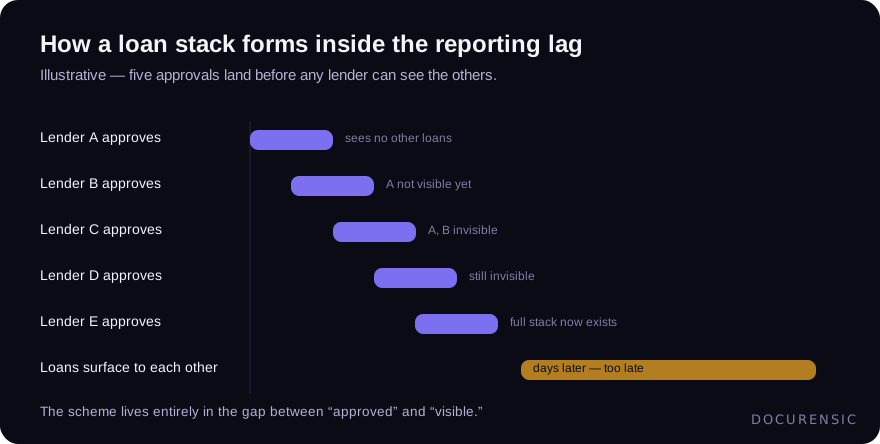
The whole scheme lives in that gap between "approves" and "surface." Close the gap and the scheme collapses.
Where documents come in
Stacking and fabricated income go hand in hand. To qualify at five lenders, an applicant often needs income evidence that supports the borrowing — and the same pay stub or bank statement, sometimes lightly edited to fit each application, gets submitted across the stack. Fabricated income is what lets a borrower who could genuinely service one small loan appear able to service five.
That's the hook for document forensics. When the income document propping up an application is fabricated or altered, tamper detection flags it regardless of how many other lenders the applicant is hitting simultaneously. You may not be able to see the other four applications in real time, but you can see that the pay stub in front of you was edited — and a fabricated income document is reason enough to decline before the stack ever completes on your end. The same reused document, submitted to you and to four competitors, is a shared weakness even when the applications aren't shared.
Defending against it
No single control catches stacking, because part of it is genuinely invisible to you. You defend by attacking every part you can see:
- Real-time and consortium signals. Where lenders share near-real-time application or inquiry data, the reporting lag shrinks and the window closes. A sudden burst of applications across a consortium is the clearest stacking signal there is.
- Velocity checks. Multiple applications from the same identity, device, or bank details in a short window — visible on your own side — is a strong flag even without shared data.
- Document forensics on income evidence. Authenticate the pay stubs, statements, and tax documents. Fabricated income is both a decline reason on its own and a frequent companion to stacking.
- Consistency across the file. As with any income fraud, reconcile the documents against each other; reused, lightly-edited evidence often carries small inconsistencies.
The mindset
Loan stacking punishes lenders who treat each application as a closed world. Some of the risk is structural and shared — solved by faster data and consortium signals across the industry. But a meaningful slice of it walks in on documents you're holding right now, and that slice you can act on without anyone's help: if the income evidence is fabricated, the answer is no, whether or not you can see the other four lenders. Tighten the reporting gap where you can, and authenticate the paper where you can't.
Frequently asked questions
What is loan stacking?
It's when a borrower takes out multiple loans from multiple lenders in a very short window — often the same day — before any of them can see the others. It exploits the lag between when a loan is issued and when it becomes visible to other lenders, letting an applicant qualify everywhere at once and end up far more leveraged than any single lender would allow.
How is loan stacking different from normal multiple borrowing?
Timing and intent. Normal borrowing happens over time, with each new obligation visible to the next lender. Stacking deliberately compresses the borrowing into the reporting blind spot so the loans are invisible to each other at decision time, frequently with fabricated income to qualify everywhere and often with no intent to repay.
Can document forensics stop loan stacking?
It stops the part fueled by fabricated income — and that's a large part. You may not see an applicant's simultaneous applications to other lenders, but you can detect that the pay stub or bank statement in front of you was edited, which is grounds to decline on its own. Combined with velocity checks and shared real-time signals, it meaningfully shrinks the opening.
Put it to the test
Scan a document and get a plain-English verdict in seconds. Free to start.
Keep reading
Fake W-2s and Tax Documents: A Lender's Verification Guide
A W-2's official look does a lot of unearned work in lending decisions. How fake tax documents are built, and how to catch them with math and cross-document checks.
Fake Proof-of-Funds Letters: Money That Exists Only on Paper
POF letters grease real estate deals, trade transactions, and investment schemes — and they are trivially forged. What a real one proves, what a fake one costs, and how to verify.

Ghost Brokers: The Insurance Agent Who Never Existed
Ghost brokers sell real-looking insurance that is worthless — forged certificates, cancelled policies, stolen details. How the scheme works and how to check a policy actually exists.