Business Email Compromise vs Invoice Fraud: Related, Not the Same
BEC and invoice fraud get lumped together, but they attack different weaknesses and need different defenses. A comparison, plus the document checks that blunt both.
When a company loses money to a fake payment request, the post-mortem usually files it under "business email compromise" or "invoice fraud" — often interchangeably. The two overlap, and one frequently rides on the other, but they're different attacks on different weaknesses. Defending against one doesn't automatically defend against the other.
The distinction that matters
Business email compromise (BEC) is an attack on identity and trust in communication. Someone convinces your staff they're the CEO, a vendor, or a lawyer — via a compromised mailbox or a lookalike domain — and instructs a payment. The channel is the weapon; there may be no forged document at all, just a persuasive email.
Invoice fraud is an attack on your payables process. A fraudulent or altered invoice enters the pipeline and gets paid like a real one. The document is the weapon; email is merely how it usually arrives.
They meet in the middle constantly — the most damaging pattern in B2B payments is a BEC-compromised vendor mailbox sending a real-looking invoice with changed bank details. Identity attack delivers document attack.
Side by side
| Business email compromise | Invoice fraud | |
|---|---|---|
| Attacks | Trust in who's talking | Trust in what arrived |
| Weapon | Compromised or spoofed email | Forged or altered document |
| Classic move | "Urgent wire, confidential — CEO" | Familiar invoice, new bank account |
| Primary defense | Email security + out-of-band verification | Document forensics + payables controls |
| Tell-tale | Domain a letter off; tone/urgency shifts | Edited PDF; font swaps; broken math |
| Backstop that works | Call-back on known number | Verify banking changes independently |
Why the distinction changes your defenses
Teams that file everything under "email problem" buy email security and stop. That's half a defense. A forged invoice doesn't care how good your spam filter is if it arrives from a genuinely compromised vendor mailbox — the email is authentic; the attachment is the lie. Filters pass it; only examining the document itself catches the edited banking block, the substituted font, the modification timestamp two hours before sending.
Teams that only check documents miss the inverse: a pure BEC wire request with no attachment at all sails past document controls. That one dies to process — out-of-band confirmation of any new payment instruction, on a channel the attacker doesn't control.
The defenses compose cleanly precisely because the attacks differ:
- Email layer — authentication (SPF/DKIM/DMARC), lookalike-domain monitoring, and a culture where urgency triggers suspicion rather than speed.
- Document layer — every incoming invoice scanned for editing traces, metadata contradictions and arithmetic breaks; automatic routing to review when an invoice carries a banking change or crosses a threshold.
- Process layer — banking changes verified via previously-known contacts, dual approval above limits, no exceptions for urgency. This layer backstops both attacks, which is why it's the one fraudsters work hardest to rush you past.
The uncomfortable takeaway
Both attacks succeed by being ordinary. The email reads like every other email; the invoice looks like every other invoice. Human vigilance fades exactly where these attacks live — the routine middle of a busy day. That's the argument for making the checks structural: machines don't get busy, and a scanner that inspects every payables document treats the five-hundredth invoice with the same suspicion as the first.
Frequently asked questions
Is invoice fraud a type of BEC?
They intersect rather than nest. Plenty of invoice fraud arrives without any email compromise (mailed, uploaded to portals, from fake vendors), and plenty of BEC involves no invoice. The overlap — compromised vendor email delivering an altered invoice — is simply the most costly combination.
What's the single best defense against both?
Out-of-band verification of payment instructions: any new or changed banking detail gets confirmed through a channel you already had. It's low-tech, it's unglamorous, and it defeats the end-game of both attacks.
Can email filters catch invoice fraud?
They catch spoofed senders and known-bad infrastructure. They do not inspect whether an attached PDF was edited — an authentic mailbox sending a doctored invoice passes every email check. Document-level scanning covers that gap.
What should we do first with a small team?
Two moves, one afternoon: write down the call-back rule for banking changes and make it absolute; put automated document scanning on your invoice intake. Together they close the two doors these attacks actually use.
Check the email you are holding
Paste a raw message header into the free analyzer to see its authentication results and the route it actually travelled. No account needed.
Keep reading
The Two-Invoice Trade: Customs Undervaluation and the Paper That Hides It
Undervalued commercial invoices dodge duties, launder value, and expose importers to seizure. How the double-invoice game works and how compliance teams catch it in the paper.
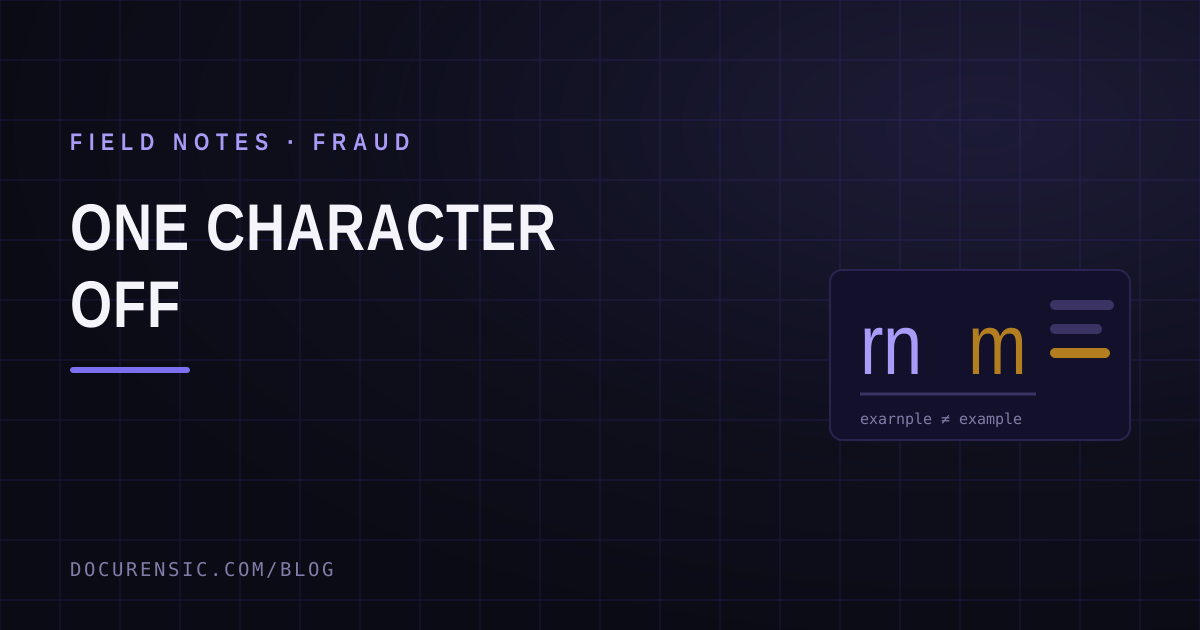
One Character Off: How Lookalike Domains Get Paid
The most effective domain in payment fraud is not a hacked one. It is a real domain, correctly configured, that differs from your supplier's by a single character nobody reads.
8 Accounts Payable Fraud Controls That Actually Get Used
Controls fail when they're annoying. Eight AP fraud controls teams actually follow — from vendor master hygiene to callback verification and document forensics.