Check Fraud Is Back: 7 Schemes Still Draining Accounts
Paper checks were supposed to die. Instead they became the soft target. The seven check-fraud schemes still working — and the boring, layered discipline that beats them.
Everyone assumed paper checks would quietly die and take check fraud with them. The opposite happened. As card and wire fraud got harder, fraudsters drifted back to the one payment instrument that still travels through the mail, still gets photographed and deposited by phone, and still relies on a signature and a routing number as its security model. Checks became the soft target precisely because everyone stopped paying attention to them.
If your business still writes or accepts checks — and most do — here are the schemes still working, and what each one is really exploiting.
1. Mail theft and check washing
The oldest trick, back in force. A check is stolen from a mailbox, and the ink is chemically "washed" off everything except the signature. The fraudster rewrites the payee and the amount on a genuine, signed check. Because the check is real — real stock, real account, real signature — it clears the first look every time.
The tell is physical: faint discoloration, a payee name that sits oddly on the paper, an amount in a slightly different ink. Positive pay (matching issued checks against a list you gave the bank) is the structural defense, because it doesn't care how good the wash was — a payee or amount that doesn't match your issued list gets stopped.
2. Counterfeit checks
No theft required — just a printer and your account details, which leak from any check you've ever sent. The fraudster prints checks on their own stock using your routing and account number. These often look too clean: the wrong paper weight, missing microprinting on the signature line, a padlock icon that's just decoration.
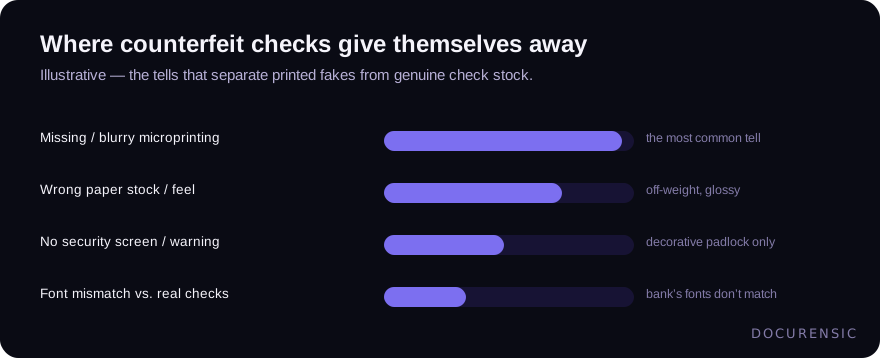
Microprinting is the workhorse check: real checks hide tiny text (often in the signature line) that reads as a solid line to the eye and resolves under magnification. Counterfeits reproduce it as a fuzzy dash.
3. Altered checks
A genuine check you wrote, edited after the fact. A payee changed, an amount bumped from hundreds to thousands, a decimal shifted. Unlike washing, the check was never stolen blank — it was legitimately received, then modified. This is straightforward document tampering, and it leaves the same fingerprints any altered document does: mismatched ink, misaligned characters, a number that doesn't match the written amount. Always reconcile the numeric and written amounts; they're a built-in checksum fraudsters forget.
4. Forged signatures
Someone signs a check they have no authority to sign, on a real account. This is a signature-authentication problem more than a document one, but the document still carries evidence — pressure, hesitation marks, and tracing artifacts in a copied signature. For businesses, the defense is procedural: dual signatures over a threshold, and reconciling cleared checks against authorized issuances quickly, because forgery is caught in the reconciliation, not the eyeball.
5. Check kiting
A timing scam that exploits float — the gap between deposit and clearing. The fraudster moves money between accounts at different banks, writing checks against funds that don't exist yet, using each deposit to cover the last. It's less about the document and more about the pattern: rapid movement between accounts, deposits and withdrawals that only make sense if you assume the money is real. Banks catch it by watching velocity, not paper.
6. Remote deposit "double dipping"
Mobile deposit created a new gap. A fraudster deposits a check by photo, then deposits the same physical check at another bank, or cashes it — collecting twice on one instrument. The document is genuine; the fraud is in depositing it more than once. Restrictive endorsements ("for mobile deposit only") and prompt destruction of deposited checks close the window.
7. Business email compromise meets checks
The modern hybrid. A fraudster impersonates an executive or vendor and requests a check be cut and mailed to a new address, or that a "replacement" check be issued for one that "never arrived." No forged document at all — just a convincing request that ends with your company mailing a real check to the wrong hands. The defense is the same out-of-band verification that stops payment-redirection fraud: confirm the request through a channel the requester doesn't control.
The through-line
Look back at the seven and a pattern emerges: only about half are really document problems. Washing, counterfeiting, and altering are forgery you can catch by examining the check. Kiting, double-dipping, and BEC-driven schemes are process problems you catch with reconciliation, velocity monitoring, and verification habits. A check-fraud program that only inspects paper will miss half of what's coming at it.
So run both. Authenticate the physical instrument — and for high-value or suspicious checks, a forensic look catches the washing and counterfeiting the eye misses — but pair it with positive pay, fast reconciliation, and out-of-band confirmation of any check request that arrives by email. The instrument is old. The discipline that beats it is boring, layered, and completely effective.
Frequently asked questions
Is check fraud really still a problem?
Yes — it's grown as other payment fraud got harder. Checks still expose your account and routing numbers on every one you send, still rely on signatures and paper stock for security, and now travel through mobile deposit, which opened new gaps like double-dipping. For many businesses, checks are now the highest-risk payment method they use.
What is positive pay?
It's a bank service where you send a list of checks you've issued — payee, amount, check number — and the bank only clears checks that match. It's the structural defense against washing, counterfeiting, and alteration, because it stops any check whose details don't match what you actually issued, no matter how convincing the physical check looks.
How can I tell a counterfeit check from a real one?
Look for missing or blurry microprinting (real checks hide tiny text that resolves under magnification), wrong paper stock, a decorative-only security padlock, and fonts that don't match the bank's real checks. Reconcile the written and numeric amounts, and for anything high-value, a forensic check will catch tells the eye misses.
Put it to the test
Scan a document and get a plain-English verdict in seconds. Free to start.
Keep reading
Wire Fraud: What to Do in the First 72 Hours
Almost everything that works on a fraudulent transfer works in the first day. Almost nothing works after the third. Here is the order to work in when it has already happened.
Fake Proof of Payment: The Screenshot That Buys Three Days
Nobody fakes a payment to steal money. They fake it to buy time — long enough to collect the goods and be somewhere else when the bank tells you nothing arrived.
One Character Off: How Lookalike Domains Get Paid
The most effective domain in payment fraud is not a hacked one. It is a real domain, correctly configured, that differs from your supplier's by a single character nobody reads.