Chain of Custody for Digital Documents: Making Evidence Hold Up
A forensic finding is only as strong as the custody story behind the file. Hashes, handling, and documentation — how to keep digital document evidence defensible.
You found the smoking gun: the invoice was edited three days after the dispute began, the metadata proves it, the case is closed. Then opposing counsel asks one question — "how do we know this is the file you received?" — and if your answer is a shrug, the finding dies. Digital evidence has a property paper never had: it can be altered invisibly, including by the people handling it honestly. Chain of custody is the discipline that answers the question before it's asked, and for digital documents it's built on one beautiful primitive: the cryptographic hash.
Key takeaways
- A chain of custody documents who had the evidence, when, and what was done to it — unbroken from acquisition to presentation.
- Cryptographic hashes make digital custody provable: matching hashes demonstrate bit-for-bit integrity in a way no signature log can.
- The working copy rule is absolute — originals are hashed and preserved; every examination happens on copies.
- Ordinary business disputes deserve custody discipline too: the practices cost minutes and decide whether findings survive challenge.
The hash is the seal
A cryptographic hash (SHA-256 in current practice) reduces any file to a fixed fingerprint that changes completely if a single bit changes. Hash the file at acquisition, record the value, and integrity verification forever after is one comparison: same hash, same file, mathematically. Standards bodies publish the underlying specifications and the forensic guidance built on them (nist.gov) — but the operational rule fits in a sentence: hash immediately at acquisition, record the value somewhere the file can't touch, and re-verify at every handoff.
This is why serious forensic reports quote document hashes alongside findings. The finding attaches to a fingerprint, not a filename — and filenames are opinions.
The custody record
The chain itself is a log with four columns: who, what, when, why. Who acquired the file, from where (the email, the portal, the export — with enough detail to reproduce the acquisition), when, and under what authority. Then every transfer, examination, and storage event after. International guidance on digital evidence handling — identification, collection, acquisition, preservation — is codified in ISO/IEC 27037 (iso.org), and its core demands are refreshingly practical: contemporaneous records, minimal handling, and demonstrable integrity at every step.
Two operational rules do most of the work:
- Never examine the original. Acquire, hash, store, copy — analysis happens on the copy. If a tool modifies the copy (opening a PDF can update "last accessed" trails in some workflows), the original remains pristine and provable.
- Record before you act. The custody log entry precedes the examination, not the write-up afterward. Reconstructed custody is challenged custody.
Why business disputes need this too
Chain of custody sounds like courtroom formalism, but the everyday version decides real money: the vendor claims the contract you hold was altered — can you prove your copy is the one they emailed? The insurer questions when the claim photo entered your system. The auditor asks whether the statement you flagged is the statement you received. Teams that hash at intake, log handling, and preserve originals answer in minutes. Teams that "have it somewhere in the shared drive" negotiate from weakness regardless of what the document shows.
The practice also compounds with forensics: an examination finding — say, an edit dated after the signature — is twice as strong when the examined file's integrity from intake is provable, because "your copy was tampered with" stops being an available counter-story.
Discipline is cheap; its absence isn't
The full discipline costs almost nothing modern tooling doesn't automate: hash on intake, store originals immutably, log access, analyze copies, quote hashes in reports. Document-analysis platforms increasingly do the scaffolding by default — recording the document's fingerprint at upload, preserving the analyzed original, and stamping findings with the hash they attach to, which is exactly how a forensic document scan keeps its own findings defensible. The examiner's conclusions are only ever as strong as the sentence "and this is provably the file." Make that sentence free.
Frequently asked questions
Is a hash enough on its own?
A hash proves a file hasn't changed since the hash was recorded — it says nothing about what happened before. That's why acquisition documentation matters: the hash seals the chain from the moment of intake, and the intake record establishes where the file came from.
Put it to the test
Scan a document and get a plain-English verdict in seconds. Free to start.
Keep reading
When Was This Really Made? A Field Guide to Document Time
Documents carry more clocks than people expect — and fraud usually breaks at least one. Where timestamps live, which ones lie easily, and how to read them together.
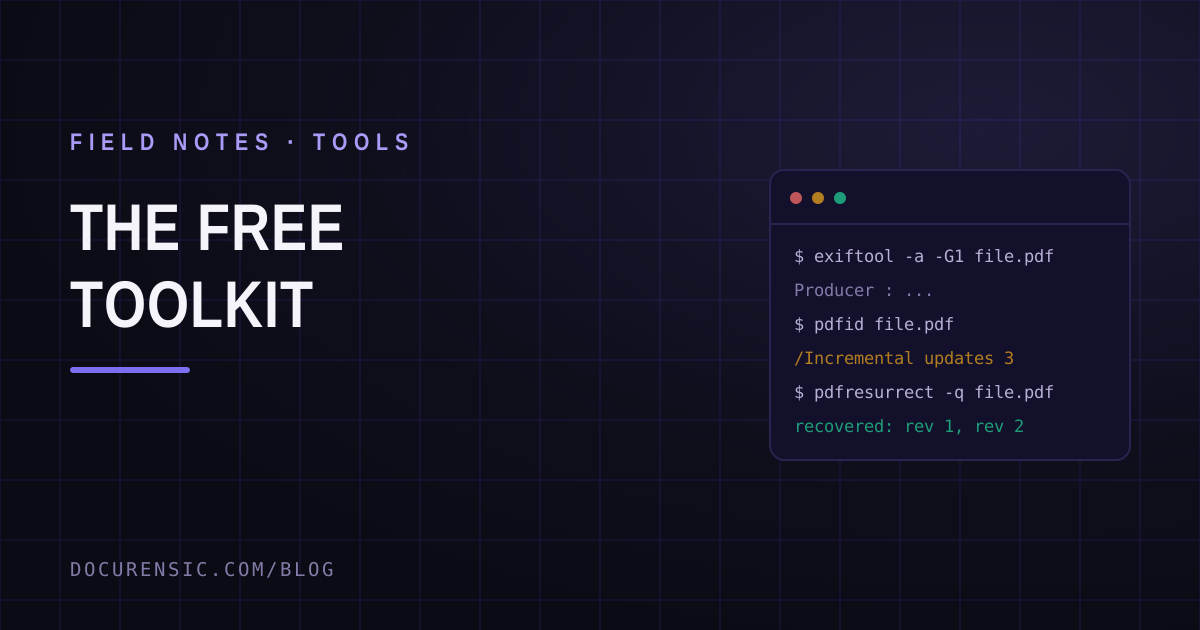
The Free Document Forensics Toolkit
ExifTool, pdfid, qpdf, mutool, FotoForensics and the rest — what you can genuinely establish about a suspicious document with software that costs nothing, in what order, and the four things free tooling cannot do.

What Fonts Give Away: Typography as Forensic Evidence
Every document has a typographic fingerprint — and edits break it. How font substitution, spacing drift, and impossible typefaces expose altered and backdated documents.