The Fake-Document Economy: Inside the Template and Generator Industry
Pay stubs in 60 seconds, bank statements to order, "novelty" diplomas — an entire industry sells document fraud as a service. How the template economy works and what its products have in common.
Type "make a pay stub" into any search engine and the first page will offer to fabricate one in under a minute — employer, wages, deductions, all yours to invent, PDF delivered instantly. The sites style themselves as payroll tools for small businesses, and some genuinely are. But around and beneath the legitimate use case sits a sprawling economy of generators, template packs, and made-to-order services whose actual product is deception: statements "for novelty purposes," utility bills "for testing," diplomas "as replacements," IDs "for entertainment." Law-enforcement takedowns of counterfeit-document marketplaces recur annually, and each one reveals the same thing — industrial volume, retail prices (europol.europa.eu).
Key takeaways
- Document fraud is a supply chain now: generators, template marketplaces, and bespoke forgery services sell the artifact; the buyer supplies the lie.
- The "novelty purposes" disclaimer is a legal fig leaf — the products are engineered to pass real verification processes.
- Mass production creates mass fingerprints: shared templates, generator metadata, recycled layout quirks, and identical math errors across thousands of fakes.
- The template economy inverts the difficulty curve — fakes are effortless to produce, so verification has to be effortless to run.
The product catalog
The economy tiers cleanly. Generators — web forms that emit pay stubs, invoices, receipts, and rent ledgers — serve the volume end: fast, cheap, minimal customization. Template packs — editable PSD/DOCX files of bank statements, utility bills, and government forms, sold through gray marketplaces — serve the DIY forger who wants control. Bespoke services — "send us your details" operations producing finished documents, sometimes with verification-callback support (a phone number that answers as the fake employer) — serve the premium end where a document alone won't survive scrutiny.
The catalog maps exactly onto what verifiers see in the wild: the fake pay stubs in tenant files, the fake bank statements in loan packets, the proof-of-address bills in KYC queues. These aren't lone-wolf Photoshop projects. They're SKUs.
Mass production means mass fingerprints
Industrialization is the fraudster's economy and the examiner's gift. Products from the same generator share DNA:
- Template invariants. The same layout skeleton, spacing rhythm, and section order across "different employers" and "different banks." Verifiers who see volume start recognizing generator houses on sight, the way numismatists recognize mints.
- Generator metadata. PDF producer strings naming the rendering library or the site itself; creation timestamps in the generator's server timezone regardless of the document's claimed geography.
- Systematic math. Generators compute deductions with simplified formulas — flat percentages where real payroll uses brackets and caps — producing withholdings that are internally consistent and externally impossible. Thousands of fakes share the same wrong math.
- Asset reuse. The same sanitized logo files, the same fake bank branch addresses, the same stock signature squiggles, recycled across every output.
A human comparing one document against one memory misses all of this. A system comparing every document against a corpus of known generator fingerprints doesn't — which is the structural argument for machine-first screening in any pipeline that ingests financial documents at volume.
The legal fig leaf
"For novelty use only" does not launder the transaction: producing or using fabricated documents to obtain money, housing, credit, or employment is fraud in essentially every jurisdiction, and buyers regularly discover that the disclaimer protected the seller's payment processor, not the customer. Consumer-protection authorities' guidance on fake-document schemes is blunt on this point (ftc.gov).
Verification has to industrialize too
The template economy's real effect is on the difficulty curve: producing a passable fake went from a skill to a purchase. Any verification process calibrated for the old world — where fakes were rare and clumsy — is now screening a population where fakes are cheap and uniform. The good news is symmetrical: uniform fakes fail uniformly. Screening every incoming document for generator fingerprints, template DNA, and metadata tells is exactly the counter-industrialization an automated document forensics check provides — assembly-line detection for assembly-line fraud.
Frequently asked questions
Are pay stub generators illegal?
The tools generally aren't; the use usually is. Generating a stub for your own legitimate payroll is bookkeeping. Submitting a generated stub as proof of income you don't earn is fraud in essentially every jurisdiction, disclaimer or not.
How do verifiers keep up as templates improve?
By shifting weight from appearance to structure and sources. Templates improve at looking right; they improve much more slowly at faking file provenance, internal math, and source-verifiable facts — which is where automated screening keeps its edge.
Check the PDF you are holding
Run a free PDF X-Ray in your browser — it recovers text from the file’s earlier revisions, so you can see what a value was before it was changed. No account needed.
Keep reading
Chain of Custody for Digital Documents: Making Evidence Hold Up
A forensic finding is only as strong as the custody story behind the file. Hashes, handling, and documentation — how to keep digital document evidence defensible.
The Document Forensics Glossary, in Plain English
Fifty-plus terms from PDF structure, image forensics and the signature world, defined for the person reading a forensic report rather than writing one — including what each one does not mean.
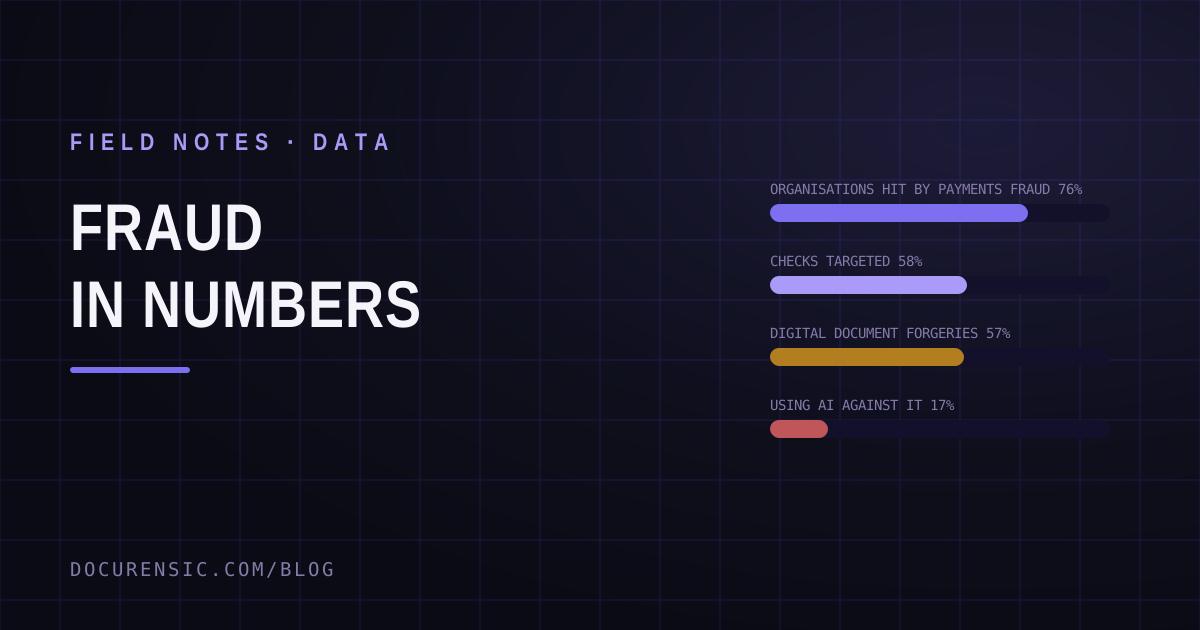
Document Fraud in Numbers: What the Data Actually Says
Every figure attributed to the body that published it, with a note on what it really measures — plus the widely-quoted statistics that do not survive a look at their sources, and a thirty-second test for any fraud number