Proof of Address Fraud: Why a Utility Bill Proves Little
A utility bill lists a name and an address and has no real security features — one of the easiest documents to fake. What proof of address is actually worth, and how to get more signal.
"Proof of address" is one of the great fictions of onboarding. We ask people to prove where they live, they upload a utility bill, we tick the box. But think about what a utility bill actually is: a document that lists a name and an address, produced by the thousands, delivered as a PDF, with no security features worth the name. It proves almost nothing, and forging one takes minutes. Yet it gates bank accounts, credit, and access to services everywhere.
If a document that claims to establish someone's address is part of your process, here's what it's really worth and how to get more signal out of it.
Key takeaways
- A utility bill is one of the easiest documents to fake — no security features, endlessly available templates, delivered digitally.
- The address on a proof-of-address document matters less than whether the document is authentic and consistent with everything else.
- Metadata and editing artifacts catch most fakes, because forgers edit a real bill rather than produce one from scratch.
- Prefer verifiable sources over uploaded documents wherever the risk justifies it.
Why the utility bill is such a weak proof
Three things make it soft. First, there's nothing to authenticate — no hologram, no barcode tied to a registry, no cryptographic anything. It's text on a branded page. Second, real ones are everywhere, so a fraudster has a perfect template to start from; they're not inventing a look, they're editing a genuine bill. Third, it arrives as a PDF, which means editing it requires no scanner, no printer, and no craft — just a text tool and a few minutes to swap the name or address.
Put those together and you have a document that's trusted far beyond what it can bear. The name and address it displays are the two fields easiest to change and hardest to feel good about.
What to actually check
Since the content is trivially editable, shift your attention to the authenticity of the file and its consistency with the rest of the application.
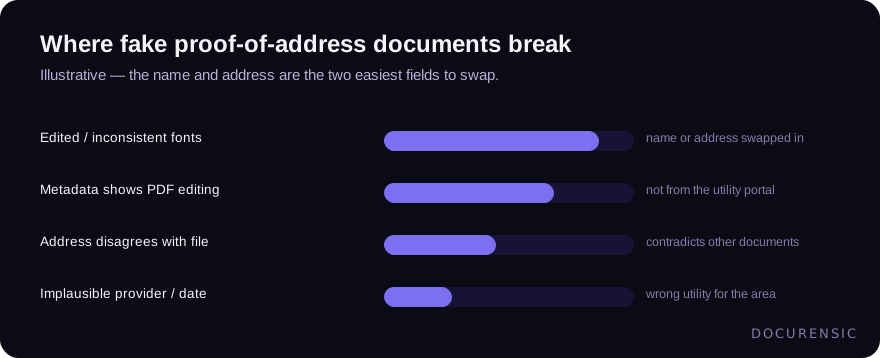
Read the file's history. A genuine bill downloaded from a utility's portal has a predictable origin — generated by their systems, with metadata to match. A bill that's been opened and re-saved in a PDF editor is telling you someone was in there. This is the same metadata story that gives away any edited document: the wrapper contradicts the claim.
Hunt for the edit seam. When a name or address is swapped on a real template, the new text rarely matches perfectly — a different font, a baseline that's slightly off, spacing that's uneven in just that one field while the rest of the bill is uniform. Fabricated proof-of-address documents fail on the same tamper tells as any other altered file.
Cross-check against the file. Does the address match everything else the applicant submitted, or does this one document disagree? Does the name match exactly? Does the utility make sense for that location? A proof-of-address document that contradicts the rest of the application is worth more as a red flag than as a proof.
Sanity-check the date and provider. A bill dated impossibly, from a provider that doesn't serve that area, or with a balance and account structure that doesn't match how that utility actually bills, is a template someone filled in carelessly.
Prefer verification over documents
The deeper fix is to stop treating an uploaded document as the strongest available proof when it's actually the weakest. Where the risk justifies it, verifiable sources beat a PDF every time — data that confirms the address against a source the applicant can't edit. Reserve the uploaded utility bill for lower-risk cases, and when you do accept one, authenticate it rather than merely reading it. The document isn't worthless; it's just not proof on its own, and treating it as proof is how the easy fraud gets in.
Frequently asked questions
Why is a utility bill considered weak proof of address?
Because it has no real security features, genuine templates are everywhere to copy, and it's delivered as an easily edited PDF. The two fields you care about — name and address — are the two easiest to change. It can support an address claim, but on its own it proves very little and is trivial to fake.
How do I detect a fake utility bill?
Focus on authenticity and consistency rather than the address text. Check the file's metadata for signs it was edited rather than issued by the utility, look for font and alignment mismatches where the name or address was swapped, confirm it agrees with the rest of the application, and sanity-check the provider and date against reality.
What's a stronger alternative to a utility bill for proof of address?
Verifiable data sources that confirm an address against records the applicant can't edit are stronger than any uploaded document. Where risk is higher, prefer those; where you still accept documents, authenticate them forensically instead of just reading the address off the page.
Put it to the test
Scan a document and get a plain-English verdict in seconds. Free to start.
Keep reading

Fake Portfolio Statements: Wealth That Only Renders
A portfolio statement is a claim about money you cannot see, issued by an institution you may not be able to contact, in a format nobody standardised. That is a lot of room to work in.
Fake Proof-of-Funds Letters: Money That Exists Only on Paper
POF letters grease real estate deals, trade transactions, and investment schemes — and they are trivially forged. What a real one proves, what a fake one costs, and how to verify.
Ghost Brokers: The Insurance Agent Who Never Existed
Ghost brokers sell real-looking insurance that is worthless — forged certificates, cancelled policies, stolen details. How the scheme works and how to check a policy actually exists.