Fake W-2s and Tax Documents: A Lender's Verification Guide
A W-2's official look does a lot of unearned work in lending decisions. How fake tax documents are built, and how to catch them with math and cross-document checks.
In this guide
Tax documents carry a quiet authority. A W-2 or a 1099 feels official in a way a pay stub doesn't — it's a government form, it has an employer's tax ID on it, it's the document people file with the IRS. That authority is exactly why fraudsters fake them, and exactly why reviewers under-scrutinize them. "It's a W-2" does a lot of unearned work in a lot of lending decisions.
If you verify income for loans, leases, or credit, here's how fake tax documents are built and how to catch them without waiting on third-party verification you may not have.
Key takeaways
- Fake W-2s and 1099s are usually real blank templates with fabricated numbers — the form is genuine, the figures aren't.
- The strongest self-checks are internal math and cross-document consistency, not the official look of the form.
- A W-2 that disagrees with the pay stubs or bank statements in the same file is the tell — fraudsters rarely make every document agree.
- Forensic checks flag the editing artifacts; procedural checks (like third-party verification) confirm the truth.
Step 1: Redo the math the form is built on
Tax forms are full of relationships that have to hold. On a W-2, the boxes aren't independent — wages, Social Security wages, and Medicare wages relate to each other in predictable ways, and the withholding amounts track proportionally to income within known rates. Fraudsters inflate the wage figure to hit a target income and forget to move everything else in step. The result is a form where the numbers don't relate the way real payroll produces them.
You don't need to be a tax preparer. You need to notice when withholding is implausibly low for the stated wages, when the tax boxes don't scale together, or when a round, tidy number sits where payroll would produce something messy. Real payroll math is ugly. Suspiciously clean is suspicious.
Step 2: Make the documents in the file agree
This is the single highest-value check, and it needs no external data. A lending file usually contains more than one income document — a W-2, recent pay stubs, maybe bank statements. They all describe the same income from different angles, so they have to reconcile:
- Does the W-2's annual wage line up with the pay stub's year-to-date figures?
- Does the take-home pay implied by the stub match the deposits on the bank statement?
- Do the employer name, address, and tax ID match across every document that shows them?
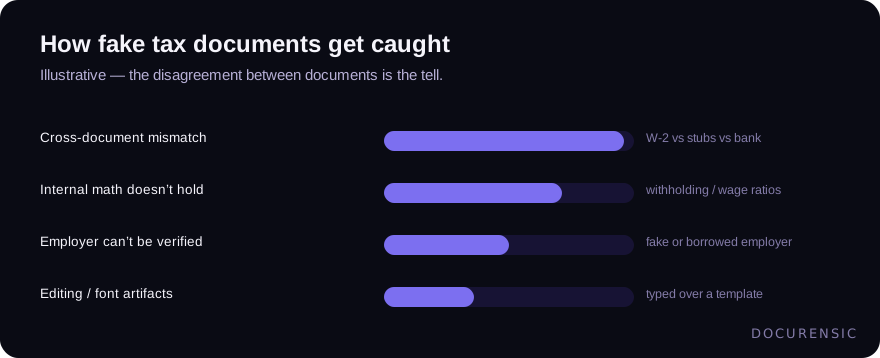
Fraudsters are good at making one document look right. They're bad at making three documents agree, because each fabrication has to be consistent with all the others, and that's hard to do by hand. Inconsistency across the file is where fabricated income falls apart.
Step 3: Check the employer is real and reachable
A fabricated income often comes with a fabricated or borrowed employer. Does the company exist? Does the tax ID have the right shape? Does the employer's address resolve to something real, or to a maildrop? Verifying the company behind the income is a step people skip because the form "looks official," and it's exactly where a synthetic employment history unravels.
Step 4: Read the document as a file, not just a page
A W-2 delivered as a PDF carries evidence beyond the printed numbers. Was it generated by legitimate payroll or tax software, or authored and edited in a general PDF editor? Do the fonts match across the form, or does the wage figure sit in a subtly different typeface than the labels around it — the classic sign of a number typed over a template? These are the same tamper tells that give away any edited document, and they don't care how official the form looks.
Step 5: Escalate to third-party verification when it counts
Self-checks tell you when something is wrong. For high-stakes decisions, confirming what's right means going to the source — verified income data, tax-transcript verification, or direct employer confirmation through legitimate channels. The self-checks above aren't a replacement for that; they're the fast filter that tells you which files deserve it, so you're not paying for third-party verification on every applicant, only the ones your own checks flagged.
Common mistakes
- Trusting the form because it's a tax form. The template is the easy part to get right. Judge the numbers, not the letterhead.
- Checking one document in isolation. The fraud hides in the disagreement between documents. Always reconcile the whole file.
- Skipping the employer check. Fabricated income needs an employer to hang on; verifying it is where many fakes die.
- Treating a clean-looking PDF as a scanned original. Metadata and fonts often reveal it was edited, not issued.
Frequently asked questions
How can I tell if a W-2 is fake without contacting the IRS?
Start with internal math and cross-document consistency: check that withholding and wage boxes relate plausibly, and that the W-2 agrees with the pay stubs and bank statements in the same file. Verify the employer exists, and inspect the PDF for editing artifacts. These catch most fabrications; third-party or transcript verification confirms the high-stakes cases.
What's the most common way fake tax documents get caught?
Cross-document inconsistency. Fraudsters can make a single W-2 look convincing, but a lending file usually has multiple income documents that must reconcile — annual wages against year-to-date stubs, take-home against bank deposits, employer details across every page. Making all of them agree is hard, so the disagreement is the tell.
Are 1099s easier to fake than W-2s?
They're structurally simpler — fewer interlocking boxes — so there's less internal math to get wrong, which can make a fabricated 1099 harder to break on the form alone. That shifts weight onto cross-document consistency and verifying the payer, since a 1099 still has to agree with bank deposits and reference a real, reachable payer.
Check the PDF you are holding
Run a free PDF X-Ray in your browser — it recovers text from the file’s earlier revisions, so you can see what a value was before it was changed. No account needed.
Keep reading

Loan Stacking: Hitting Five Lenders in One Afternoon
A borrower can be creditworthy at 9am and dangerously over-leveraged by noon. How loan stacking exploits the reporting lag between lenders — and where documents give it away.
Fake Proof-of-Funds Letters: Money That Exists Only on Paper
POF letters grease real estate deals, trade transactions, and investment schemes — and they are trivially forged. What a real one proves, what a fake one costs, and how to verify.
Ghost Brokers: The Insurance Agent Who Never Existed
Ghost brokers sell real-looking insurance that is worthless — forged certificates, cancelled policies, stolen details. How the scheme works and how to check a policy actually exists.