Apostille vs. Legalization: Verifying Documents Across Borders
International documents carry authentication chains most reviewers have never been taught to read. How apostilles and consular legalization work — and how both get faked.
Showing posts tagged “verification”.

There is no single test, and detector scores are guesses. A ranked set of checks that still work, from content credentials to the physics a generator gets wrong, and the question that matters more than 'is it AI?'
International documents carry authentication chains most reviewers have never been taught to read. How apostilles and consular legalization work — and how both get faked.
POF letters grease real estate deals, trade transactions, and investment schemes — and they are trivially forged. What a real one proves, what a fake one costs, and how to verify.
Ghost brokers sell real-looking insurance that is worthless — forged certificates, cancelled policies, stolen details. How the scheme works and how to check a policy actually exists.

Extraction, identity verification, document forensics, media forensics and registry lookup answer five different questions. Most bad purchases in this market are the right vendor in the wrong category — here is how to te
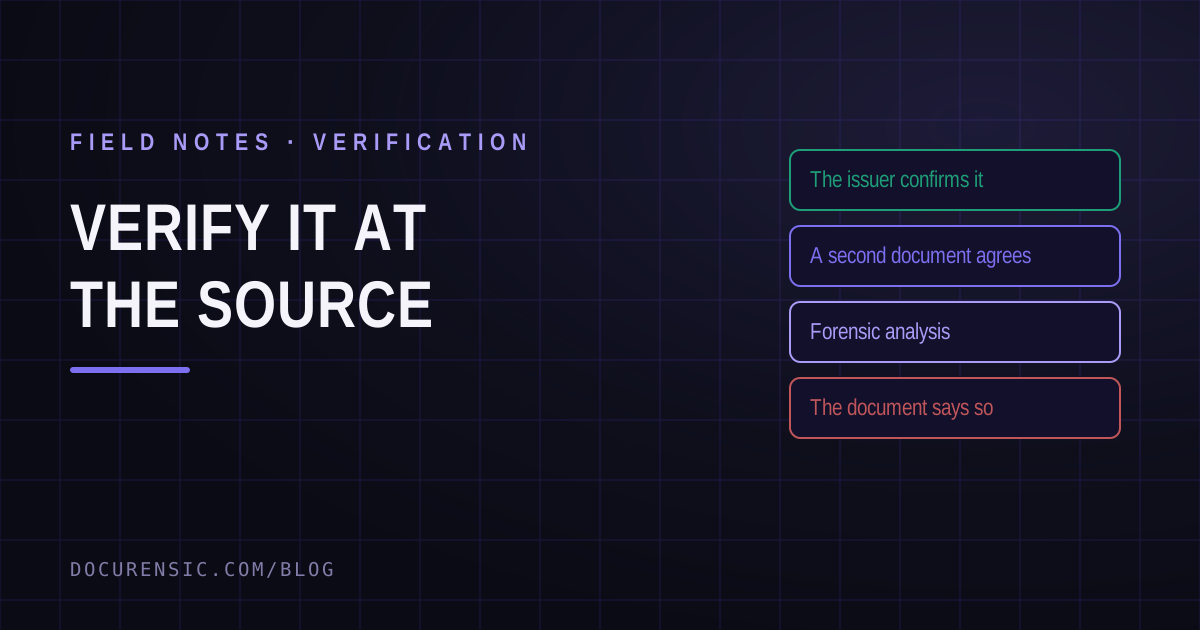
Issuer confirmation outranks every form of analysis, including ours. A directory of the free official registries — companies, sanctions, licences, education, travel documents — and the rule that stops a fake verification
A tender is decided almost entirely on paperwork — certificates, accounts, references, insurance. Most of it is scored once, by someone with forty other submissions to read, and never checked again.

A portfolio statement is a claim about money you cannot see, issued by an institution you may not be able to contact, in a format nobody standardised. That is a lot of room to work in.
An employment verification letter is a salary claim on a letterhead. Why this document is the easiest fake in the file, and the source-check that defeats every version of it.
A trust seal is a picture. Copying a picture takes one right-click. Yet a row of badges in a website footer still moves purchase decisions more than almost anything else on the page.

Everything a sender types can be forged. Everything the relay servers stamped on the way through cannot be rewritten after the fact — which is why the headers are where the answer lives.
Nobody fakes a payment to steal money. They fake it to buy time — long enough to collect the goods and be somewhere else when the bank tells you nothing arrived.
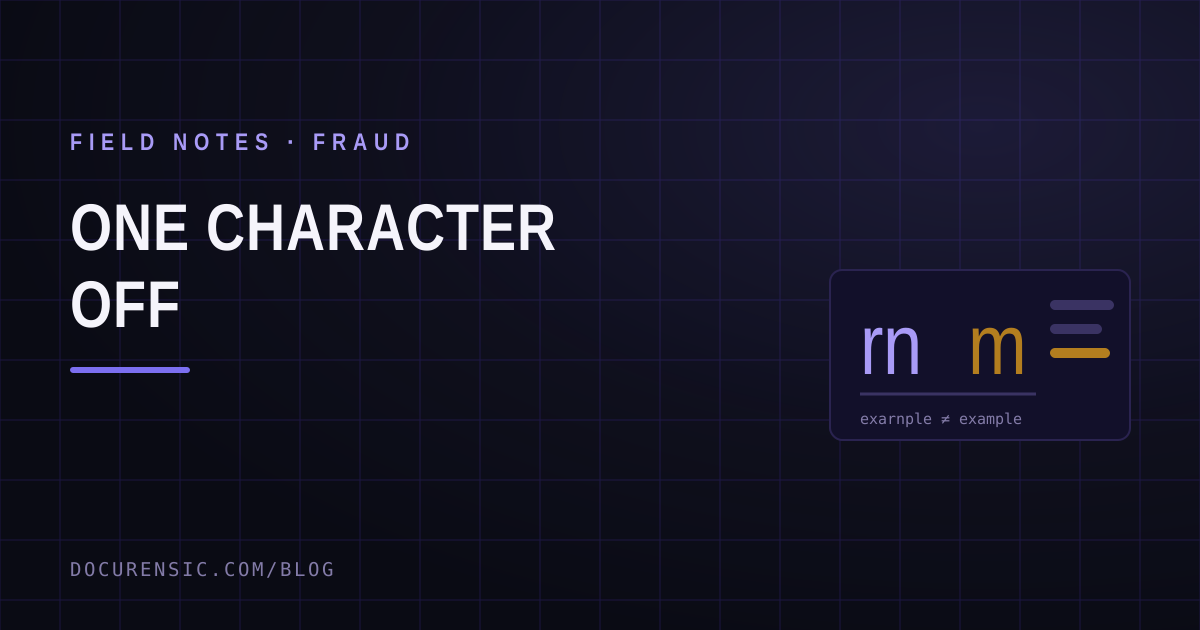
The most effective domain in payment fraud is not a hacked one. It is a real domain, correctly configured, that differs from your supplier's by a single character nobody reads.