How to Verify a Notarized Document (and Spot a Fake Stamp)
A notary seal is an ink impression, and ink is easy to fake. The trust belongs to the commission record, not the stamp. How to check whether a notarization really happened.
In this guide
- Key takeaways
- Step 1: Read everything the seal claims
- Step 2: Confirm the notary is real and currently commissioned
- Step 3: Look at the seal impression itself
- Step 4: Verify the underlying document, not just the notarization
- Step 5: Watch for the remote-notarization gaps
- Common mistakes
- Frequently asked questions
A notary stamp is supposed to mean something: that a real official watched a real person sign a real document and confirmed they were who they claimed. In practice, the stamp itself has become a thing people trust instead of verifying, which is exactly backwards. A notarial seal is an ink impression. Ink impressions are easy to fake. The trust belongs to the notary's record, not to the mark on the page.
If notarized documents cross your desk — affidavits, deeds, powers of attorney, agreements — here's how to check whether the notarization actually happened, rather than just admiring the stamp.
Key takeaways
- The stamp is not the proof — the notary's journal entry and commission record are.
- Fake notarizations usually pair a copied or invented seal with a notary who's not commissioned, expired, or out of jurisdiction.
- Every seal carries verifiable facts: notary name, commission number, jurisdiction, and expiration — check them against the official record.
- The document under the stamp still needs its own authenticity check; a real notarization on an altered document is its own kind of fraud.
Step 1: Read everything the seal claims
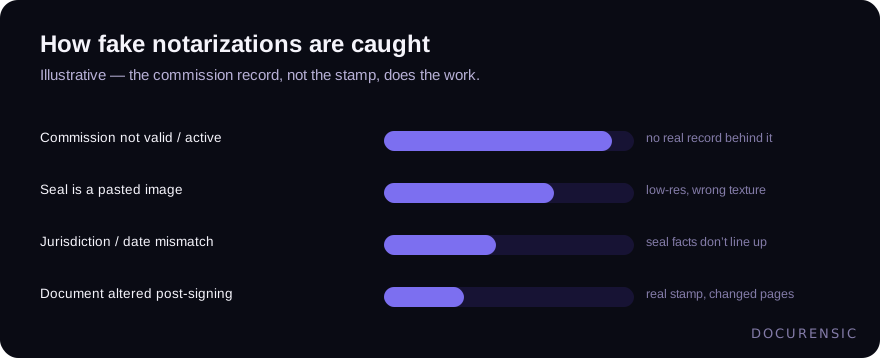
A notarial seal isn't decoration; it's a set of assertions. It states the notary's name, their commission number, the jurisdiction they're commissioned in, and — depending on where — a commission expiration date. Each of those is a fact you can test. Start by simply reading them carefully, because careless fakes fail here first: a commission number in the wrong format, a jurisdiction that doesn't match where the signing supposedly happened, an expiration date that predates the notarization.
Step 2: Confirm the notary is real and currently commissioned
This is the check that matters most and the one most people skip. Notaries are commissioned by a public authority, and that commission is a matter of record. A named notary either holds a valid, current commission for that jurisdiction on the date of the act, or they don't. A fake notarization frequently uses an invented notary, a real notary's name with a wrong commission number, or a commission that had already expired on the date stamped.
Confirming the commission is active, matches the name and number on the seal, and covers the date of the notarization defeats a large share of fakes on its own — because forgers can copy a seal's appearance far more easily than they can conjure a valid commission record to back it.
Step 3: Look at the seal impression itself
Genuine seals — whether embossed or inked — have consistent, crisp characteristics. Forged ones betray themselves: a seal that's clearly a low-resolution image pasted onto the page, edges that are pixelated, a "raised" embossment that's actually flat printing, or an impression that sits on top of the text in a way a physical stamp wouldn't. When a document arrives as a scan or PDF, these are the same image and tamper tells that expose any pasted element — a seal dropped in with editing software rarely matches the rest of the page's texture and resolution.
Step 4: Verify the underlying document, not just the notarization
Here's a subtlety that trips people up. A notarization can be perfectly genuine and the document still be fraudulent — if pages were swapped, terms altered, or content added after the notary saw it. Notarization attests to a signing event; it doesn't freeze the document forever. So authenticate the document on its own terms too: check for signs it was altered after the notarial act, page inconsistencies, or content that doesn't match the acknowledgment. A real stamp on a doctored agreement is a favorite move precisely because the stamp lends borrowed credibility.
Step 5: Watch for the remote-notarization gaps
Remote online notarization is legitimate and growing, but it changes the evidence. There's no physical embossment; the assurance lives in the platform's audit trail, the notary's electronic commission, and the tamper-evident seal on the resulting document. That can be stronger than paper — a proper remote notarization is cryptographically sealed — but it also means a "remotely notarized" PDF with none of that underlying trail, just a picture of a seal, is a red flag. Know which kind you're looking at, and check the evidence that kind is supposed to carry.
Common mistakes
- Trusting the stamp as the proof. The stamp is a claim. The commission record is the proof.
- Skipping the commission check. Confirming the notary is real and currently commissioned for that jurisdiction on that date catches the most fakes.
- Ignoring the document under the seal. A genuine notarization doesn't authenticate content added or altered afterward.
- Treating a pasted seal image as a real impression. Scans and PDFs make it easy to check the seal's texture and resolution against the page.
Frequently asked questions
How do I verify a notary is legitimate?
Read the commission details on the seal — the notary's name, commission number, jurisdiction, and expiration — and confirm against the commissioning authority's record that the commission is real, matches those details, and was active on the date of the notarization. A copied seal is easy; a valid commission record behind it is not.
Can a notarized document still be fraudulent?
Yes. Notarization attests to a signing event, not to the document forever after. Pages can be swapped or terms altered after the notary's act, and a genuine seal then lends false credibility to a doctored document. Always authenticate the underlying document separately for signs of alteration.
How can you tell a fake notary stamp on a scanned document?
Look at the seal as an image: forged seals are often low-resolution pastes with pixelated edges, a flat "embossment," or a texture and resolution that don't match the rest of the page. Combined with checking the commission facts and the document's own integrity, a pasted seal usually gives itself away.
Check the PDF you are holding
Run a free PDF X-Ray in your browser — it recovers text from the file’s earlier revisions, so you can see what a value was before it was changed. No account needed.
Keep reading

Fake Proof-of-Funds Letters: Money That Exists Only on Paper
POF letters grease real estate deals, trade transactions, and investment schemes — and they are trivially forged. What a real one proves, what a fake one costs, and how to verify.

Ghost Brokers: The Insurance Agent Who Never Existed
Ghost brokers sell real-looking insurance that is worthless — forged certificates, cancelled policies, stolen details. How the scheme works and how to check a policy actually exists.
Fake Court Papers: The Scam That Arrives With a Gavel
Fabricated subpoenas, arrest warrants, and settlement notices weaponize fear of the legal system. How to recognize fake legal documents — and what real courts never do.