Where Document Fraud Actually Concentrates, by Industry
'Document fraud' means something different in freight, lending, insurance, and HR. Where the risk concentrates by industry — and why the forgery technique should decide your defense.
In this article
- Key takeaways
- The map, at a glance
- Freight & logistics: the impersonation problem
- Lending & credit: the tampering problem
- Insurance: the fabrication problem
- Accounts payable: low volume, high stakes
- HR and legal: rare, but the per-case damage is real
- What this means for your program
- The schemes that ignore your industry lines
- Frequently asked questions
Ask ten people what "document fraud" means and you'll get ten answers, because the phrase means something completely different depending on which industry you sit in. A freight broker pictures a hijacked load. A mortgage underwriter pictures a doctored bank statement. An insurer pictures a receipt that was never issued by the store on it. Same two words, wildly different threat.
That's not a trivia point. It's the reason so many document-verification programs underperform: they're built to catch a generic "fake document" when what's actually hitting them is a specific document, forged a specific way, for a specific payout. This is a field note on where the risk actually concentrates — by industry — and what changes about the defense when you stop treating fraud as one thing.
A note on the numbers below: they're illustrative, drawn from the shape of what we see teams triage, not a cited external study. The point is the relative pattern, which is stable and useful, not a precise statistic you should quote.
Key takeaways
- Document fraud isn't one problem — it's a different top threat, target document, and payout in each industry.
- Freight and lending see the highest-velocity, highest-dollar document fraud; HR and legal see lower volume but outsized per-case damage.
- The forgery technique clusters by industry too: freight leans on impersonation, lending on tampering, insurance on fabrication.
- The right control isn't "verify documents" in the abstract — it's matching the check to the technique the fraud actually uses against you.
The map, at a glance
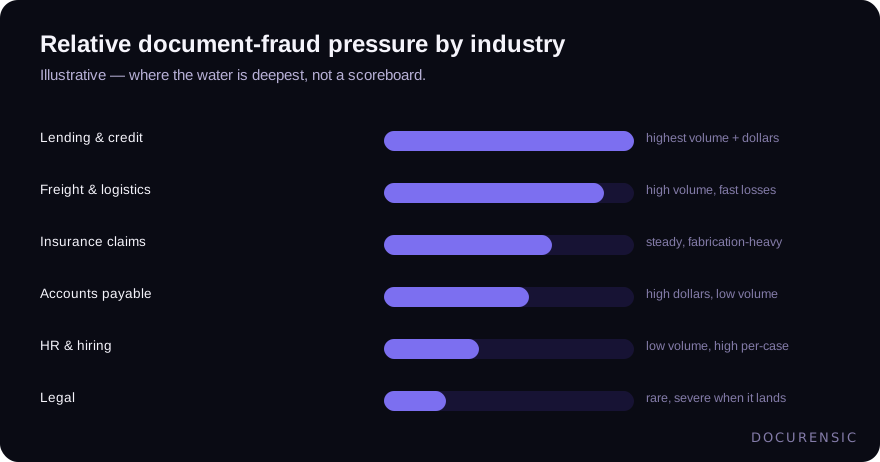
Here's the relative concentration of document-fraud pressure across the industries we work with most. Read it as "where the water is deepest," not as a scoreboard:
Now the more useful cut. It's not just how much fraud each industry sees — it's how the documents are faked. Impersonation, tampering, and fabrication are three different crimes that need three different checks.
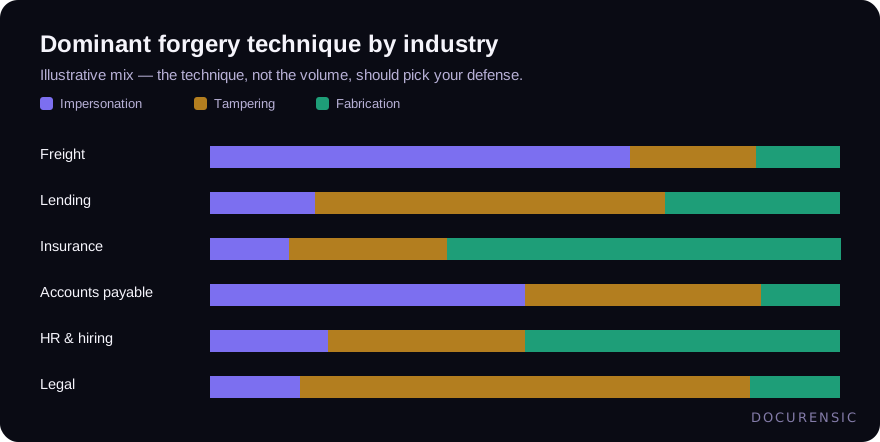
If you take one thing from this note, take that second chart. A freight team that invests everything in tamper detection is guarding the wrong door, because their real problem is impersonation — someone pretending to be a carrier who is real. An insurer obsessed with catching edits will miss the receipt that was fabricated whole and never tampered with because it never existed.
Freight & logistics: the impersonation problem
Freight fraud is mostly about who, not what. The classic scheme is double brokering — a load handed to someone posing as a legitimate carrier, then re-brokered and sometimes stolen outright. The documents involved (rate confirmations, a certificate of insurance, a bill of lading) are frequently real documents used by the wrong party, or lightly altered copies of a genuine carrier's paperwork.
That changes the defense. Tamper detection helps at the margins, but the money check is verifying the entity: is this carrier who they claim to be, is the insurance certificate actually current and issued to them, does the MC number's paperwork hold together. It's a company-verification problem wearing a document-fraud costume. The losses are fast — a load is gone in a day — which is why the checks have to run at booking speed, not after the fact.
Lending & credit: the tampering problem
Lending is where document tampering peaks, because the payout is tied directly to numbers on a page. A bank statement with an inflated balance. A pay stub with edited earnings. A tax document with a better income than the real one. These are genuine templates with the critical figures changed — and because they started as real documents, they look right until you check the internals.
This is the sweet spot for forensic document analysis. Edited PDFs carry the fingerprints of the edit: metadata that says a "scanned" statement was authored by editing software, fonts that don't match across a single field, math that doesn't reconcile. And it's where the highest-velocity fraud lives, because loan applications are a firehose and the fabrication is easy to attempt at scale. Layer this with the synthetic-identity problem — clean documents around a fake person — and lending carries the heaviest combined load of any industry on the map.
Insurance: the fabrication problem
Insurance fraud leans on documents that were made up whole rather than edited. A receipt for property that was never bought, from a store that never issued it. An invoice for repairs that didn't happen. A medical bill for treatment no one received. There's often nothing to "tamper-detect" because there was no original — the document is a clean fabrication.
The defense shifts accordingly. You're checking whether the document is consistent with a real issuer and a real transaction: does this receipt match how that merchant actually formats receipts, does the invoice reference a vendor that checks out, does the metadata betray a template generator. Photo evidence adds its own layer — EXIF data on a claim photo can quietly contradict the story about when and where the damage happened. Volume is steady rather than spiky, but fabrication is patient and repeatable, so it compounds.
Accounts payable: low volume, high stakes
AP fraud is the inverse of lending's profile — fewer attempts, much bigger single hits. The dominant play is impersonation dressed as a routine request: a vendor bank-account change that redirects a real payment to a fraudster, or an invoice for goods never delivered from a vendor that looks legitimate. One successful redirect can dwarf a month of lending losses.
Because the volume is low, AP can afford scrutiny that a firehose can't. The highest-leverage control isn't glamorous: verify every banking-detail change out-of-band, and run inbound invoices through a check that catches the fabricated or altered ones before they enter the payment run. The automation angle matters here — the fraud hides inside a legitimate-looking, high-trust workflow, so the check has to sit inside that workflow, not beside it.
HR and legal: rare, but the per-case damage is real
HR sees fabrication — invented diplomas, fake employment history, altered references — at low volume, but a bad hire into a sensitive role is expensive in ways that don't show up as a fraud loss. Legal fraud is rarer still and skews hard toward tampering: a contract altered after signing, a backdated document, a notarization that never happened. When it lands, the stakes are a case, a settlement, or a compliance failure — so the low frequency is cold comfort.
The common thread across both: the technique is knowable, so the check should be targeted. HR verifies credentials and screens for fabrication. Legal proves documents haven't changed since execution. Neither needs the high-throughput machinery lending does; both need precision.
What this means for your program
The mistake I see most often is buying "document verification" as a single generic capability and pointing it at everything equally. The map above says that's backwards. Your program should be weighted toward the technique that your industry actually faces:
| Industry | Weight your defense toward | Because the fraud is mostly… |
|---|---|---|
| Freight | Entity / carrier verification | Impersonation |
| Lending | Tamper & metadata forensics | Tampering |
| Insurance | Fabrication & issuer consistency | Fabrication |
| Accounts payable | Out-of-band change verification | Impersonation in a trusted flow |
| HR | Credential verification | Fabrication |
| Legal | Post-execution integrity | Tampering |
None of this means you ignore the other techniques — every industry sees some of each, which is exactly why a good forensic engine runs impersonation, tampering, and fabrication checks together and lets the verdict tell you which one fired. It means you should know, before you buy or build anything, which door the fraud is most likely to come through in your business. Then you can stop guarding all of them equally and start guarding the right one well.
The schemes that ignore your industry lines
There's a catch to organizing your defense by industry: the fraudsters don't. Some of the most effective schemes deliberately cross the lines the map above draws, because the seams between industries are exactly where nobody's clearly responsible.
Consider a fabricated invoice that also carries a forged certificate of insurance to satisfy a freight broker's compliance step — that's insurance-style fabrication deployed against a freight-style impersonation target. Or a synthetic identity, built patiently in the lending world, that then applies for trade credit as a "business," dragging the tampering-and-fabrication toolkit into an accounts-payable relationship. Or a compromised email account that requests both a vendor bank-account change (AP) and a "replacement" check reissued to a new address (payments) in the same week, because the operator found one soft target and is working every payout it touches.
The lesson isn't that the industry map is wrong — it's that your program has to be joined-up even when your teams aren't. The two failure modes I see:
- Handoff gaps. Onboarding verifies the identity, AP verifies the invoices, and nobody verifies that the entity onboarded is the same coherent thing the invoices are coming from. The fraud lives in the handoff.
- Inconsistent scrutiny. A document that would be flagged instantly in the lending queue sails through the procurement queue because procurement never built the muscle. Fraudsters find the softest queue and route everything through it.
The practical fix is a shared verification standard rather than a per-team one: the same document, submitted anywhere in your organization, gets the same forensic scrutiny and the same verdict. That's the argument for a common forensic layer feeding every workflow instead of each team improvising — not because it's tidier, but because the cross-industry schemes specifically hunt for the team that's improvising.
Frequently asked questions
Which industry has the most document fraud?
By volume and dollars combined, lending and credit typically carry the heaviest load, because the payout is tied directly to figures that are easy to edit and applications arrive at high volume. Freight is close behind on velocity, with fast, hard-to-reverse losses. The "most" depends on whether you're measuring frequency, dollars, or speed of loss.
Why does the same fraud check work differently across industries?
Because the forgery technique differs. Lending fraud is mostly tampering with real documents, so metadata and edit-detection checks shine. Insurance fraud is mostly fabrication of documents that never had an original, so consistency-with-a-real-issuer checks matter more. A control tuned for one technique underperforms against another.
Is document forensics enough on its own?
For tampering and fabrication, it's the core control. For impersonation — the dominant threat in freight and much of AP — it's necessary but not sufficient; you also need entity verification and out-of-band confirmation of high-risk changes. The strongest programs combine document forensics with identity and business verification.
How do I know which technique my business faces most?
Look at your actual losses and near-misses, not the headlines. Categorize each incident as impersonation, tampering, or fabrication. The distribution almost always clusters, and that cluster tells you where to weight your controls — usually along the lines of the industry map above.
Check the PDF you are holding
Run a free PDF X-Ray in your browser — it recovers text from the file’s earlier revisions, so you can see what a value was before it was changed. No account needed.
Keep reading
Mortgage File Fraud: 6 Documents Borrowers Doctor Most
Income, assets, employment, occupancy — mortgage fraud is mostly document fraud. The six file exhibits underwriters should trust least, and what each fake looks like.
The Document Remembers: Recovering What a PDF Used to Say
Change a PDF and save it, and most software leaves the old version physically inside the new one. Sometimes the amount before the edit is still sitting there, waiting to be read.
Synthetic Identity Fraud: The Scam With No Victim to Call
Synthetic identities are built, not stolen — a fake person nurtured into a creditworthy profile, then busted out across lenders. Why it beats your checks, and what actually stops it.