Fake Portfolio Statements: Wealth That Only Renders
A portfolio statement is a claim about money you cannot see, issued by an institution you may not be able to contact, in a format nobody standardised. That is a lot of room to work in.
A bank statement is hard to fake well because everybody has seen one. There is a house style, there are running balances that have to add up, there are transaction descriptions with a particular grammar, and the person reading it has looked at a thousand.
A brokerage statement is a different proposition. Formats vary wildly between institutions. Crypto platforms invent their own. Most reviewers have seen very few, and almost nobody has seen one from the specific offshore platform named at the top of the page. That unfamiliarity is the whole opportunity.
Key takeaways
- Fake portfolio statements serve three jobs: proving funds you do not have, attracting investors into something that does not exist, and stalling a withdrawal that will never happen.
- Arithmetic is the fastest attack surface — fabricated positions rarely reconcile against quantity, price, cost basis and the stated total.
- Market data is public and unforgiving. A closing price that never occurred on the stated date, or a trade dated to a market holiday, is a hard contradiction.
- Independent confirmation is the only real verification. A statement the subject can email you is not evidence; a read-only link or a direct confirmation from the custodian is.
What the document is being used for
Proof of funds. A property purchase, a business acquisition, a visa application, a lease on something expensive. The statement is presented as evidence that the person can complete. It rarely gets scrutinised because it is a supporting document rather than the transaction itself — which is exactly why it is the one to fabricate. The same dynamic runs through fake bank statements.
Attracting investment. A track record. Screenshots and statements showing consistent returns, used to raise money into a fund or scheme that may not exist at all. Here the statement is the product: the returns are the pitch, and the pitch is a PDF.
Stalling a withdrawal. The endgame of most investment scams. The victim wants their money out, and instead receives a beautifully rendered statement showing a large balance, plus a reason it cannot be released yet — a tax, a fee, a compliance hold. The statement's job is to make the balance feel real enough to justify sending more money to unlock it.
That third use is the cruellest and the most common. The balance was never anything but a number in a web page.
What a real statement is forced to contain
Regulated custodians produce statements under rules, and rules leave shapes.
Complete position detail. Instrument identifiers, quantity, cost basis, current price, market value, and unrealised gain — per holding. Fabricated statements tend to summarise, because inventing a self-consistent portfolio line by line is real work.
Arithmetic that closes. Quantity times price equals market value. Positions sum to a subtotal. Subtotals plus cash equals the reported total. Opening balance plus transactions plus market movement equals closing balance. This is the single most productive place to spend five minutes, because a fabricator who adjusted one number to reach a target usually adjusted it in one place only.
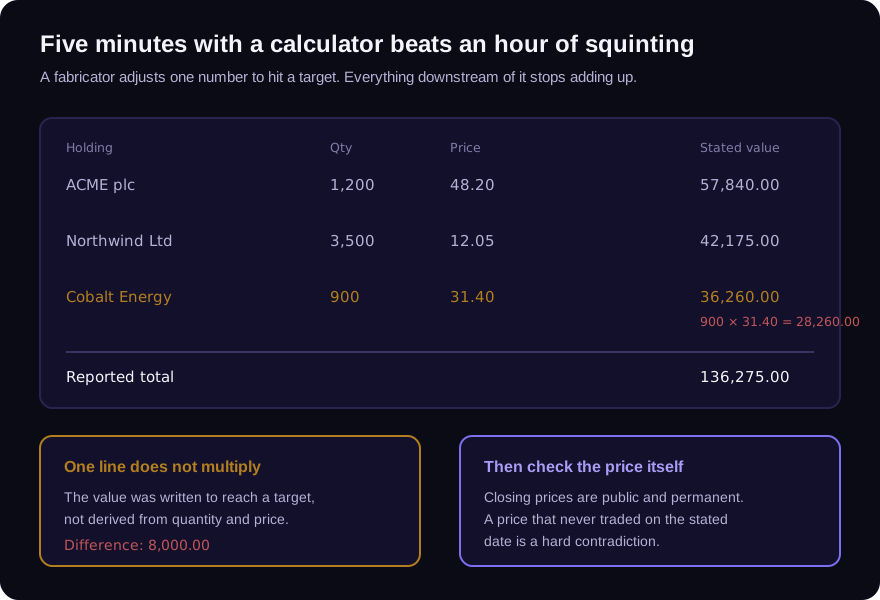
Correct identifiers. ISIN, CUSIP, SEDOL, ticker — and they have to match the instrument named next to them. Made-up identifiers do not resolve. Real identifiers attached to the wrong security do not match. Both are checkable in seconds.
Real prices on real dates. Closing prices are public and permanent. A position valued at a price the instrument never traded at on the stated date is not a rounding difference, it is a fabrication. So is a transaction dated to a weekend or a market holiday, or a "closing price" for a market that was shut.
Regulatory furniture. Custodian name and registration, investor-protection statements, complaints procedures, the specific boilerplate a regulator requires. It is dull, it is long, and fabricators trim it because it does not help the pitch.
Consistency with every other statement from the same institution. Real statements are machine-generated. The same producer software, the same fonts, the same layout, month after month. Three statements from the same custodian that differ in typography were not produced by the same system.
The crypto variant
Digital-asset "statements" deserve their own treatment because the honest ones are structurally weaker.
There is no standard format. Many platforms issue nothing at all beyond a web dashboard, which is why so much of what circulates is a screenshot — and a screenshot is the cheapest forgery in the book. Interfaces are pure HTML, so a balance can be changed in a browser's developer tools in about four seconds and photographed.
The counterweight is unusually strong: on public chains, the ledger itself is verifiable. If someone claims a holding at an address, that address's balance is a matter of public record. Which means the honest question is not "does this statement look right" but "which address, and can I look at it?"
Refusal to name an address, or an address whose history does not match the claimed activity, is more informative than any amount of document analysis.
Two cautions. Controlling an address is not the same as being able to spend from it — anyone can point at a wealthy address. And balances on an exchange are not on-chain at all; they are a database row at a company. If the company is fictitious, so is the row.
Checks in order of cost
Do the arithmetic. Ten minutes with a calculator. Positions, subtotals, totals, and the period reconciliation. This catches more fabrications than anything else on this list.
Spot-check three prices against market history. Pick the largest positions and look up the closing price on the stated date. It is free, and a mismatch is a hard contradiction rather than a soft signal.
Verify the institution exists and is regulated. National regulators publish searchable registers of authorised firms, and most also publish warning lists of entities operating without authorisation (sec.gov). A custodian that does not appear in any register, or appears on a warning list, ends the conversation.
Check that the identifiers resolve. Ticker and ISIN together, against the named instrument.
Look at the file, not just the page. Real statements come from institutional document systems. Producer strings, embedded fonts and revision history are all consistent across a given issuer's output. A statement whose structure shows it was edited after generation is a different artifact from one that was generated once. Our free PDF X-Ray will show you the revision structure without an account.
Then stop analysing and confirm independently. This is the step that actually verifies.
Why independent confirmation is the only real answer
Everything above is triage. It finds bad fakes and it raises questions about good ones. It cannot confirm that an account exists and holds what it claims, because every artifact in the process arrived from the person making the claim.
Real verification means the information reaching you by a route the subject does not control:
- A read-only broker link granted directly to you, or an aggregator feed with view-only access.
- A confirmation letter sent by the custodian to you, at contact details you obtained from the custodian's own published site — not from the statement.
- A regulated third-party verification service, where the relationship is between the verifier and the institution.
- For digital assets, an address and a signed message proving control, checked against the public chain yourself.
The distinguishing feature is the same in every case: the subject cannot stand between you and the source. A statement they emailed you fails that test no matter how good it looks, and a beautiful document that fails it is worth exactly as much as an ugly one.
A note on the pressure
Fabricated statements almost never arrive alone. They come with a deadline, an opportunity closing, another buyer, a compliance window. That is not incidental — the document is designed to survive a quick look, and the pressure exists to guarantee it only gets one.
The most useful thing you can do with a portfolio statement is take it away and read it tomorrow. Fabrications survive urgency. They rarely survive arithmetic.
Frequently asked questions
How do I verify a brokerage statement is real?
Reconcile the arithmetic, check a few prices against public market history, confirm the custodian appears in its regulator's register, and then obtain confirmation through a channel the subject does not control — a read-only link or a letter direct from the custodian.
Can a bank or broker confirm a statement for me?
Often yes, with the account holder's written authorisation. Contact the institution using details from its own published website, never from the statement, and expect the process to take days rather than minutes.
Are crypto portfolio screenshots ever reliable?
On their own, no — a browser can be edited in seconds. For on-chain assets, ask for the address and verify the balance yourself on a public explorer. For exchange balances there is no public ledger, so the only evidence is what the exchange itself confirms.
What is the fastest single check?
Arithmetic. Quantity times price against stated value, positions against subtotals, subtotals against the total. Fabricators adjust one number to hit a target and rarely propagate it through everything else.
Put it to the test
Scan a document and get a plain-English verdict in seconds. Free to start.
Keep reading
Fake Proof-of-Funds Letters: Money That Exists Only on Paper
POF letters grease real estate deals, trade transactions, and investment schemes — and they are trivially forged. What a real one proves, what a fake one costs, and how to verify.
Proof of Address Fraud: Why a Utility Bill Proves Little
A utility bill lists a name and an address and has no real security features — one of the easiest documents to fake. What proof of address is actually worth, and how to get more signal.
Fake Audit Reports: Borrowing a Big Four Signature
Fabricated audit opinions and doctored financial statements borrow credibility no fraudster earned. How fake audits are built, famous ways they unravel, and how to verify one.