Fake Professional Licenses: When the Credential Is the Con
Nurses, engineers, contractors, financial advisers — fabricated license certificates are cheap to make and expensive to trust. How to verify a professional credential at the source.
A professional license is a strange kind of document: the paper (or PDF) is worthless, and everyone treats it as priceless. The actual license is a record in a regulator's database. The certificate is just a souvenir of that record — and souvenirs are easy to fake. Every year, boards and licensing authorities publish disciplinary lists that include people who practiced for months or years on a fabricated certificate that nobody ever checked against the register.
If you hire, contract, or credential people in regulated roles, this is the gap you're exposed to: the certificate gets filed, the register never gets called.
Key takeaways
- A license certificate is evidence of nothing by itself — the authoritative record is the regulator's register, and most registers are searchable online for free.
- Fakes cluster into three types: pure fabrications, altered genuine certificates (name or date swapped), and real certificates for lapsed or revoked licenses.
- The certificate file itself often betrays editing — fonts that don't match, misaligned seals, metadata showing a consumer editor touched a "issued" document.
- Verification is a two-step habit: check the file, then check the source. Skipping either leaves a hole.
The three kinds of fake
Pure fabrications are built from a template or a downloaded sample. They tend to fail on details a real issuer never gets wrong: the license number format, the issuing body's exact legal name, the signature block, the current seal design. Regulators change seals and formats over the years — a 2026 issue date on a 2015-era template is a quiet contradiction.
Altered genuine certificates are harder. The fraudster takes a real colleague's certificate and swaps the name, or takes their own expired license and moves the date. Visually these can be excellent, because 95% of the document is authentic. This is where file forensics earns its keep: the edited field frequently sits in a different font rendering, at a subtly different baseline, or in a PDF whose modification history postdates its claimed issue date.
Valid-but-dead licenses are the most overlooked. The certificate is 100% genuine — but the license behind it lapsed, or the board suspended it. No amount of staring at the paper catches this one. Only the register does.
Verify at the source, always
Nearly every licensing body maintains a public lookup: state nursing and medical boards, engineering boards, contractor licensing agencies, financial regulators. For financial professionals specifically, the SEC points consumers to free adviser and broker checks before handing anyone money (sec.gov), and the FTC's guidance on vetting contractors makes the same point for the trades (ftc.gov). The routine is the same everywhere:
- Find the issuing authority yourself — never follow a link or phone number printed on the certificate.
- Search the register by name and license number.
- Confirm four things: the license exists, it's active, it covers the claimed scope of practice, and the holder's details match the person in front of you.
- Screenshot or save the register result with a date — that's your audit trail.
Read the file before you trust the picture
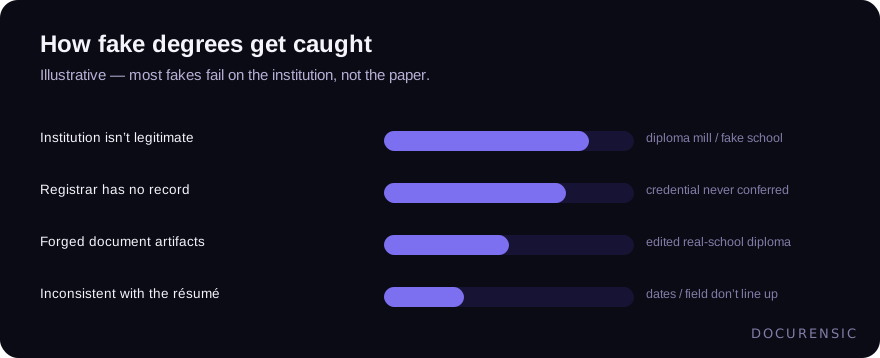
When the credential arrives as a PDF or a photo, spend one minute on the artifact itself before the register check. Was this "scanned certificate" actually produced by a photo editor? Does the metadata show a creation date last week for a license supposedly issued in 2019? Do the name and date sit in a font the rest of the document doesn't use? These are exactly the tells that degree verification relies on, and they transfer directly — a license is just a degree with a renewal date.
Make it a gate, not a vibe
The organizations that get burned by fake licenses almost never lacked the ability to verify — they lacked the habit. The certificate looked right, the person interviewed well, the file went in the drawer. Turning verification into a hard gate — no register confirmation, no start date — costs minutes per hire. Automating the first half, the file-level check that flags an edited or fabricated certificate before a human ever opens it, costs even less; that screening layer is precisely where a document forensics tool fits in a credentialing workflow, leaving the register check as the human's one job.
Put it to the test
Scan a document and get a plain-English verdict in seconds. Free to start.
Keep reading
Fake Proof-of-Funds Letters: Money That Exists Only on Paper
POF letters grease real estate deals, trade transactions, and investment schemes — and they are trivially forged. What a real one proves, what a fake one costs, and how to verify.
Ghost Brokers: The Insurance Agent Who Never Existed
Ghost brokers sell real-looking insurance that is worthless — forged certificates, cancelled policies, stolen details. How the scheme works and how to check a policy actually exists.
Tender Fraud: When the Winning Bid Is a Forgery
A tender is decided almost entirely on paperwork — certificates, accounts, references, insurance. Most of it is scored once, by someone with forty other submissions to read, and never checked again.