Trust Seals and Badges: The Cheapest Credibility Online
A trust seal is a picture. Copying a picture takes one right-click. Yet a row of badges in a website footer still moves purchase decisions more than almost anything else on the page.
Every element of a fraudulent shopfront costs something. A convincing product catalogue takes work. A plausible about-page takes writing. A payment flow takes integration.
A row of trust badges in the footer costs one right-click, and it is the element that does the most work — because visitors treat a seal as a third party vouching for the site, when almost always it is the site vouching for itself.
Key takeaways
- A seal is an image. Copying it is trivial, and there is no technical mechanism that stops it.
- A genuine seal is verifiable: clicking it goes to the issuer's own domain and shows a live record for that specific site. A fake one links nowhere, links to itself, or shows a static image.
- Award logos, membership marks and "as seen in" strips are the same trick with less scrutiny, because nobody thinks to check a magazine logo.
- Almost nothing about badges correlates with legitimacy. Registration age, a real physical address and a working phone number correlate far better and are much harder to fake.
The ten-second test
There is exactly one thing worth doing with a trust seal, and it takes ten seconds.
Click it.
A genuine seal is delivered by the issuer and links to a live verification page on the issuer's own domain, showing a record for that specific site — usually the domain name, the certification status and a date. Some are served as a script from the issuer, so the badge cannot render at all unless the certification is current.
A copied seal does one of four things:
- Nothing. It is a flat image with no link. This is the most common case by a distance.
- Links to the same page. An
href="#"or a link back to the site's own homepage. - Links to the issuer's marketing page, not to a verification record for this site.
- Opens a verification page hosted on the same domain as the shop, dressed up to look like the issuer's.
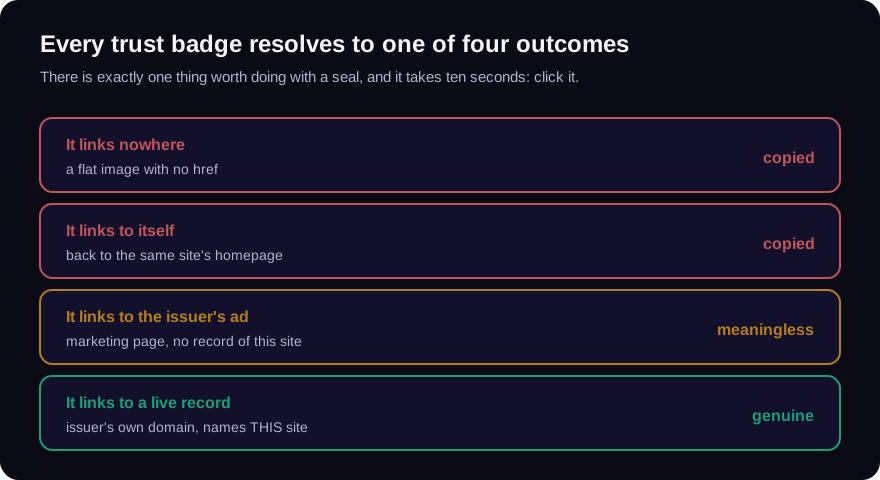
That fourth one is the only version that takes effort, and the check still works: look at the domain in the address bar. A verification record for a site should not be served by that site.
The categories, and how each fails
Security scan seals. "Site secured", "scanned daily", "malware free". Genuine ones are issued by a scanning vendor and link to a live status page. Copied ones are static. There is also a subtler failure: a real seal that is honestly reporting a scan which found nothing, on a site whose problem is not malware but that it sells goods it does not ship.
Payment logos. Card network marks, wallet logos, "secure checkout". These are the most-copied images on the internet and they are almost never verifiable, because the brands publish them for legitimate merchants to use. The real question is not the logo but the checkout: does the payment actually run through a recognised processor, or is the site asking for a bank transfer, a gift card, or cryptocurrency? A shop with every card logo in the footer that will only accept a bank transfer has told you everything.
Certification and standards marks. ISO, industry bodies, professional associations. Most issuers maintain public registers of certified organisations. This is the category where verification is easiest and least often done — the register is online, searchable, and takes a minute (iso.org). Note that a valid certificate covers a specific scope and a specific site; "we are ISO 9001 certified" from a company whose certificate covers one subsidiary's production line is technically true and practically meaningless.
Awards and rankings. "Best supplier 2025", "Top 50 innovators". Some are real, many are pay-to-enter schemes where the award is the product, and some are simply invented. The check is whether the awarding body publishes a winners list you can find yourself, and whether that list contains this company for that year.
Press strips. "As featured in" followed by newspaper logos. Almost never checkable, frequently based on a paid placement or a single passing mention, and occasionally based on nothing. Search the publication for the company name; if there is no article, there is no feature.
Review scores. A star rating rendered as an image is not a review score, it is a picture of one. Genuine review-platform widgets pull live data from the platform and link to the profile. And even a real profile deserves a look at the shape of the reviews rather than the number: a two-year-old site with four hundred five-star reviews all posted in the same three weeks is a purchase, not a reputation.
Membership marks and the trade-body trick
A specific variant worth naming. Fraudulent operators love the logos of trade associations, ombudsman schemes and regulators, because those marks carry implied recourse — the visitor reads them as "if this goes wrong, someone will help me."
Most such bodies publish a member register. Most fake users of the mark are not on it. And in the regulated cases, displaying the mark without authorisation is itself an offence, which makes it one of the few badge misuses with a real reporting route: tell the body whose mark is being used. They tend to act quickly, because the mark is their entire asset.
What actually correlates with legitimacy
If badges are noise, what is signal? Broadly, things that cost time or expose an identity:
- Registration age. A domain that has existed for years is not proof of honesty, but fraud infrastructure is disposable and disposable things are new.
- A physical address that resolves. Not a mail-forwarding suite, not a virtual office. Check it on a map and see whether the business is there.
- A working phone number answered by a human who knows what the company sells.
- A company registration number that matches the national register, with the trading name and address to match.
- Content with a history. Pages indexed for years, an archive, a social presence with real interactions rather than a burst of activity last month.
- A checkout that uses a real processor, and a returns policy that is specific rather than generic.
- Consistency across all of it. Fraud infrastructure is assembled quickly from mismatched parts. Legitimate businesses accumulate a coherent footprint by accident, over time.
Notice that none of these are things a site can grant itself by pasting an image.
Checking the footprint instead of the footer
Most of that list is infrastructure, and infrastructure is checkable without visiting the site. Our free URL checker reads the domain's registration record and age, the certificate the server actually presents, the mail and DNS policy, the technologies in use, and whether the risk signals corroborate each other — from our servers, so you never load the page.
It will not tell you whether the trust badge in the footer is real. It will tell you whether the domain behind the badge was registered nine days ago, which answers the same question faster.
The deeper point is one we keep coming back to: verification that the subject can grant themselves is not verification. A seal you can copy, a certificate you can email, a statement you can render — the artifact is only worth something when it reaches you by a route the subject does not control. That is as true of a footer badge as it is of a company you are about to onboard.
Frequently asked questions
How do I check if a trust badge is real?
Click it. A genuine seal links to a verification record on the issuer's own domain, naming this specific site. A badge that does not link anywhere, links to itself, or shows a verification page hosted on the same site is a copied image.
Do trust seals actually make a site safer?
No. At best a seal reports the outcome of a scan or an audit that happened at some point. It says nothing about whether the business ships goods, honours refunds, or exists.
Are review scores on a website trustworthy?
Only if they are a live widget linking to a profile on the review platform. A rendered star rating is a picture. Even genuine profiles deserve a look at review timing and language, because bulk-purchased reviews arrive in clusters.
What should I look at instead?
Domain registration age, a physical address you can find on a map, a phone number a human answers, a company number in the national register, and whether the checkout uses a real payment processor. All of them are harder to fake than an image.
Put it to the test
Scan a document and get a plain-English verdict in seconds. Free to start.
Keep reading
One Character Off: How Lookalike Domains Get Paid
The most effective domain in payment fraud is not a hacked one. It is a real domain, correctly configured, that differs from your supplier's by a single character nobody reads.
The Padlock Lies: What HTTPS Actually Proves
The padlock is the most misunderstood symbol on the internet. It certifies the pipe, not the shop — and almost every phishing page you will ever see has one.
Fake Proof-of-Funds Letters: Money That Exists Only on Paper
POF letters grease real estate deals, trade transactions, and investment schemes — and they are trivially forged. What a real one proves, what a fake one costs, and how to verify.